


Event marketing strategy: The complete guide to drive attendance & ROI
Event marketing strategy: The complete guide to drive attendance & ROI
Most event organizers do not have event marketing problems. They have a strategy problem. Dates are locked in. Venue is confirmed. Speakers are signed. And yet, registration numbers are lower than they should be. How can this be solved?
An efficient event marketing strategy connects event goals to the targeted audience, events channels to its timeline, and on-site experience to post-event pipeline. Event organizers who build that structure consistently outperform those who do not. This guide covers every step of the marketing strategy, from defining your event marketing plans to measuring ROI, whether you are organizing a trade show, a B2B conference, or an association summit.
Event marketing takeaways
- A good event marketing strategy connects your goals, audience, channels, and timeline across every phase: before, during, and after the event.
- Defining one clear objective upfront determines every downstream decision for your event marketing: which channels to activate, how much to spend, and how to measure success.
- Event marketing must be leveraged during three phases: Pre-event (to drive registrations), during the event (to turn attendance into relationships and pipeline), and post-event.
- Use Swapcard to run your full event marketing operation, from registration and AI-powered matchmaking to exhibitor lead capture and post-event analytics, in one platform.
What is event marketing?
Event marketing is the practice of using live experiences to promote a brand, build relationships, and generate business outcomes. Unlike other marketing channels, it works in two directions: using events to promote a brand, and using marketing to make those events succeed.
What makes event marketing different is the quality of connection it produces. A 20-minute face-to-face conversation builds more trust than a dozen email touchpoints. A well-run networking session creates relationships that a retargeting ad cannot replicate. Experiential marketing consistently ranks among the most effective tactics for B2B marketers, precisely because that human element is hard to manufacture any other way.
The numbers reflect that value. According to Allied Market Research, the global event industry is on track to reach $2.19 trillion by 2028. Events now represent 14% of overall marketing budgets, making them the second-largest marketing expenditure behind digital advertising. That level of investment requires more than a checklist. It requires a strategy.
In-person, virtual, and hybrid events: What each format demands from your marketing
Before you build your event marketing plan, you must understand which type of events you are planning and what each format requires from a marketing standpoint. Event marketing trends that shape each format are distinct and promotional tactics that work for a trade show look quite different from those that work online:
- In-person events reward early urgency and peer amplification
- Virtual and hybrid formats demand more sustained digital engagement.
In-person events
In-person events produce the highest-quality lead interactions and the strongest brand impressions of any format. The tradeoff is logistics: higher costs and longer lead times mean your event marketing timeline must start at least twelve to sixteen weeks out.
Your messaging should lean on exclusivity, early-bird pricing, and peer recommendations, because most attendees need travel approval, budget sign-off, and calendar blocking before they can commit. Give them enough time to say yes.
Virtual event marketing
Virtual events reach global audiences at a fraction of the logistical overhead, but no-show rates run 40% or more of registrants (Livestorm). Virtual event marketing has its own rules: you are not asking someone to book a flight, but you are asking them to protect time in a calendar full of competing priorities.
Build strong anticipation, deliver compelling content previews, and maintain consistent touchpoints from sign-up to login.
Hybrid events
Hybrid events give you the broadest reach of any format, but they require two distinct marketing strategies executing in parallel. Your in-person and virtual attendees have different motivations, different experience expectations, and different follow-up needs. Marketing to both as if they are the same person produces messaging that resonates with neither.

Pro Tip
Your event format should follow your audience, not your preference. Ask: where does your target attendee prefer to engage? What format delivers the most value for their time and budget? Let those answers drive your format decision. Then build your strategy around it.
How to define your event marketing goals and objectives
Every effective event marketing strategy starts with a clear answer to one question: what does event success look like for this event? To answer that question, you must define a specific, measurable outcome. Clear goals upfront make every downstream decision easier: which channels to prioritize, how much to spend, what to say, and how to measure effectiveness when the event is over.
The most common event marketing goals fall into four categories:
- Lead generation: Filling your pipeline with qualified prospects who attend, engage, and convert
- Brand awareness: Reaching new audiences and strengthening your positioning in the market
- Revenue: Ticket sales, event sponsorship packages, exhibitor fees, or upsell opportunities at the event itself
- Community and retention: Deepening relationships with existing customers, members, or partners
Once you have defined your event goals, build SMART objectives around them: Specific, Measurable, Achievable, Relevant, and Time-bound. The difference between "we want more attendees" and "we want 800 qualified registrations from mid-market B2B technology companies in North America by October 15th" is the difference between aspirational thinking and a roadmap you can execute and evaluate.
Another crucial point to remember: one event, one primary goal. Trying to optimize for lead generation, brand awareness, and revenue simultaneously usually means none can be achieved efficiently. Pick your priority and align your entire event program around it: channels, messaging, and budget allocation all point in the same direction.

Know your target audience before you plan anything
Your strategy can only be as strong as your understanding of who you are trying to reach. Market the right event to the wrong audience and registration will stall. Market your event to the right audience with the wrong message and the same outcomes will occur.
Start by building a clear attendee profile, asking the following questions:
- Who is my ideal attendee? (job title, industry, company size, seniority level)
- What problems are they trying to solve? What would make this event obviously worth their time?
- What has stopped them from attending similar events in the past?
- Where do they discover events: LinkedIn, industry newsletters, peer recommendations, Google search?
- What have past attendees said they valued most?
If you have executed previous events, your registration and engagement data is your most valuable research asset. Who attended? Who registered but did not attend? Which sessions drove the most engagement? What feedback scores came back from your post-event survey? Those patterns are more reliable than assumptions.
For first-time events or new audience segments, talk to a handful of target attendees before you write a line of promotional copy. The language they use to describe their challenges is the language your marketing should reflect. If they say, "I never know which sessions are actually worth attending," you have your headline. If they say, "I go to events to meet people but always end up in the same conversations," you have your networking pitch.
A common mistake is treating all potential attendees as one group. A first-time attendee and a returning customer are at completely different points in their relationship with your event. They respond to different messages. The more precisely you segment, the more relevant your communication becomes, and the higher your conversion rate.
Pre-event marketing: How to promote your event and drive registrations
The pre-event phase is where the bulk of your marketing work happens. Promoting events effectively at this stage means awareness, desire, and conversion. To create an event marketing campaign that actually converts, you require a structured promotional calendar with clear channel assignments and hard deadlines for each phase:
- Event page and registration strategy
- Email marketing campaigns
- Social media
- Speakers and sponsors
- Digital marketing and paid advertising
Your event page and registration strategy
Your event website and registration page are the conversion engine behind every marketing channel you use. Every email, social post, and paid ad ultimately drives traffic here. The objective here is to convert.
A strong event page communicates value above the fold: who should attend, what they will gain by attending, and why they cannot miss your event. The essentials of a strong event website and registration page are:
- A benefit-driven headline that explains what the event delivers, not just its name
- Speaker and session highlights that generate excitement about the agenda
- Social proof: Past attendance numbers, testimonials from previous years, partners, and sponsor logos
- An urgency mechanism: Early-bird pricing, a limited-capacity notice, or a registration deadline
- A short registration form with as few required fields as possible. Every additional field in your registration form reduces your conversion rate. Collect what you need to follow up effectively, not everything you would like to know. You can gather more information through the event app, post-event surveys, and CRM enrichment.
Email marketing campaigns
Email is the highest-converting channel when you promote your event. It consistently outperforms social and paid ads in direct response, particularly for B2B events where your target audience already knows you. However, a single announcement email is not a campaign.
Most potential attendees require multiple touchpoints before they commit to registering. Structure your email sequence across three phases:
- Save-the-date (10 to 14 weeks out): Early announcement to capture intent and start building your list
- Nurture sequence (6 weeks to 2 weeks out): Speaker spotlights, agenda reveals, exhibitor previews, and early-bird deadline reminders
- Last-chance push (1 week to 48 hours before): Urgency-focused emails that convert fence-sitters and prep confirmed attendees
According to Mailchimp, segmented email campaigns generate significantly higher open rates and click-throughs than generic broadcasts. Even basic personalization, such as the recipient's first name, their industry, or a reference to a session relevant to their role, moves conversion rates meaningfully. This may take longer to set up, but there are returns at every stage.
Social media as part of your event promotion strategy
Social media's role in event marketing is primarily top-of-funnel: generating awareness, amplifying your speakers and sponsors, and keeping your event visible across the weeks leading up to it. Social media rarely converts directly, but it creates the context that makes your emails and registration page more efficient.
For B2B events, LinkedIn is currently the best platform to prioritize, especially when using the following tactics:
- Regular organic posts from your company page, two to three per week from six weeks out
- Speaker and sponsor content tagging, so their audiences see your event
- Short video content: Session previews, behind-the-scenes clips, speaker introductions
- LinkedIn Events for additional organic reach to your followers and their networks
Consistency matters more than volume. A steady presence keeps your event in the feed without fatiguing your audience. However, it is crucial to plan your content calendar before launch, so you are not at risk of running out of ideas in week three of a six-week promotional sprint.
Speaker and sponsor amplification
Speakers and sponsors are the most underused amplification asset in most event marketing strategies. To optimize amplification, give them the tools to easily promote the event: pre-written LinkedIn posts, short email copy, branded graphics, a clear timeline, and a personal ask from your team.
Digital marketing and paid advertising
Digital marketing channels, both paid and organic, work as a system, not in isolation. LinkedIn Ads, Google Search, and retargeting amplify your organic efforts rather than replace them. They are most valuable for reaching audiences outside your existing network and for retargeting users who visited your event page but did not register.
For B2B event marketing, LinkedIn Ads with job title and company size targeting tend to outperform broad social or display formats. Google Search Ads on intent keywords like "[industry] conference [year]" capture audiences who are actively searching for events like yours. As such, both channels benefit from tight audience definitions. On the contrary, the broader your targeting, the lower your registration quality.

Pro TipDo not wait until your event page is live to start building your audience. A simple landing page with an "interested" or "remind me" option, launched 4 to 6 weeks before registration opens, lets you warm up your list before you ask for the conversion.
How to engage attendees during the event
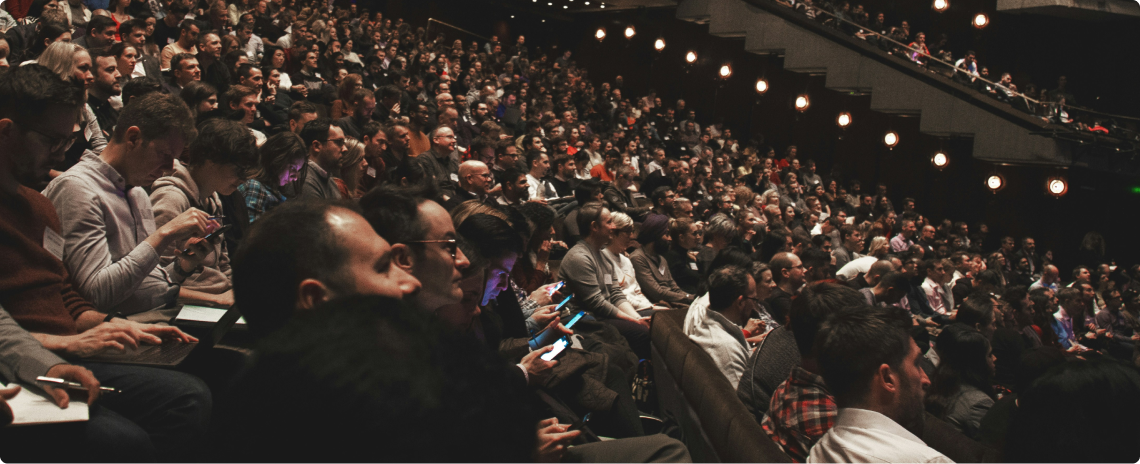
Your event marketing does not stop when the doors open. What happens during the event shapes everything that comes after: the stories attendees tell, the content they share, the leads they become, and whether or not they come back. The on-site experience is the centerpiece of your marketing, not a separate operational matter.
Networking and AI-powered matchmaking
For most B2B event attendees, networking is the primary reason they show up, often ranked above the sessions and the speakers. Yet, poorly organized networking is one of the most consistent complaints in post-event surveys.
AI-powered matchmaking changes this. The right platform analyzes attendee profiles, stated goals, and behavioral data to surface the most relevant connections before the event begins. Swapcard's State of Event Engagement report, which analyzed over 2,000 events and 2.5 million participants, found that AI recommendations increased connection requests by 47%. The same report shows that 67% of networking activity happens before the event day, which means your networking strategy, and the tools supporting it, must be activated well before attendees walk through the door.
Live engagement tools
The best events are conversations, not presentations. The tools you use to engage attendees during sessions (live polling, real-time Q&A, audience response systems, and gamification) keep them active and invested, and give you live data on what is resonating. Sessions with active participation score higher in post-event satisfaction surveys and stay in recall longer.
From a marketing standpoint, high on-site engagement also drives social sharing. Attendees who are actively participating post about their experience, and each post extends your reach to people who were not in the room, which in turn creates authentic social proof.
Real-time lead capture for exhibitors
If your event includes exhibitors, lead capture is one of the highest-value features you can give them. How an event stand performs, in terms of connections made, meetings held, and leads captured, is what exhibitors report back to their management. Digital lead capture tools replace the old badge-scan-and-spreadsheet workflow with instant access to qualified contact data, session attendance history, and engagement signals, directly from the show floor.
Exhibitor ROI is a key factor in renewal decisions. According to Swapcard's research, 75% of lead generation happens outside of badge scanning, and exhibitors miss more than 60% of attendee outreach due to unaccepted connection requests. The richer the data and guidance you give exhibitors, the stronger their ROI story, and the easier it is to retain them and grow their investment at future events.
Pro TipBrief your team on active listening during the event. Every conversation your staff has is market intelligence. What questions keep coming up? What objections do you hear on the show floor? Capture these themes in real time, as they feed directly into your post-event content and follow-up strategy.
Post-event marketing: How to turn attendees into pipeline
The seventy-two hours after your event closes are the most underutilized window in event marketing. Attendees are still energized. Conversations are still fresh. The relationships built on the show floor are still warm. However, many event teams let that window go cold while they recover from the logistics. For organizers, this represents a significant missed opportunity.
A structured post-event roadmap converts that momentum into a pipeline. Your post-event roadmap should cover three areas:
- Follow-up emails
- Content repurposing
- Lead nurturing
Follow-up email sequences
Send your first follow-up within 24 hours of the event’s closure, ideally the same evening or the next morning. This email should:
- Thank attendees with specific references to what happened at the event
- Deliver on-demand access to session recordings or key resources
- Include a short post-event survey: Three to five questions, low friction
- Tease what is coming next: A future event, a new resource, an upcoming product announcement
Your second follow-up email, sent three to five days later, can go deeper — session recaps, speaker quotes, data highlights from the event, and a soft CTA toward your next conversion step. This is where segmentation demonstrates its impact. Attendees who visited your product demo area should get a different email than those who only attended keynotes. Both are warm leads, but they are warm in different ways.
Content repurposing
Every event generates significant reusable content, especially if you plan for it before the event rather than after:
- Session recordings become on-demand video
- Panel discussions become blog posts or podcast episodes
- Keynote highlights become social clips
- Data shared on stage becomes research reports
One event can fuel weeks of content across every channel in your marketing mix. Assign someone to capture quotes, data points, and audience reactions in real time. The faster you publish post-event content, the more search traffic and social engagement you can capture while the event is still fresh in your audience’s mind, and while industry conversations are still active.
Lead nurturing and CRM handoff
Not every attendee is ready to buy immediately after your event. What matters is that no lead goes cold by default. Every registered attendee should enter a nurture sequence that keeps them engaged with relevant content until they are ready to take the next step. This is where your marketing efforts and your sales motion must be fully aligned.
Make sure your event platform integrates with your CRM so that engagement data (sessions attended, networking meetings held, content downloaded) flows automatically into your sales team's view. The richer the context your sales team has on each lead, the more relevant their outreach. And relevant outreach consistently converts better than generic cold follow-up.
This CRM integration also builds your data foundation for future events. This data tells you which channels brought your highest-converting attendees, which sessions correlated with closed deals, and which attendee profiles converted fastest — a strategic edge that compounds over every event cycle.
How to measure event marketing success and ROI
Event ROI measurement is one of the most consistent pain points in the industry. 45% of B2B event organizers expect at least a 3x return one year after hosting an event (according to the Livestorm report), but many struggle to demonstrate that return as they have not set up the right measurement framework upfront.
Accurately measuring success across your event program requires three sets of metrics: one for each phase of the event lifecycle. Together, they give you a complete picture of performance and a clear baseline for improving your next event.
Event marketing KPIs: The three-phase measurement framework
Think of your event marketing’s KPIs in three groups:
Pre-event KPIs
These key performance indicators show how well your marketing is converting awareness into registrations:
- Registration volume and weekly pace against your target
- Registration source breakdown: Which channels drive the most sign-ups at the lowest cost
- Email open rates, click-through rates, and unsubscribe rates across your sequence
- Event page traffic, bounce rate, and registration conversion rate
- Cost per registration by channel, to guide your paid investment
During-event KPIs
These metrics show how well your event is delivering on its promise:
- Attendance rate, registered vs. actual check-ins (typically 60 to 70% for in-person events)
- Session attendance and drop-off rates by time slot and topic
- Networking activity: Meetings requested, meetings held, connections made through the app
- App engagement score: Polls answered, content downloaded, notifications opened
- Exhibitor lead capture volume and average lead quality score
Post-event KPIs
These metrics measure real business impact:
- Net Promoter Score from post-event survey
- Pipeline generated: Number and value of qualified leads attributed to the event
- Pipeline influenced: Existing opportunities that accelerated after attendees engaged
- Revenue attributed: Closed deals where the event was a documented touchpoint
- Sponsor and exhibitor satisfaction scores and renewal intent rate
To measure effectiveness consistently across events, use the same KPI framework each time. In doing so, you will start to see patterns: registration conversion rates improving after you restructured your email sequence, networking adoption rates climbing after you added AI matchmaking.

Pro Tip
While revenue attribution can be challenging, it remains essential to undertake. Even a simple mechanism, like asking your sales team to flag event contacts in the CRM, or using UTM parameters on post-event follow-up links, gives you directional data to justify your investment and improve your strategy for future events.
Event technology: The tools every event marketing strategy needs
The gap between event teams that hit their numbers consistently and those that do not is usually based on infrastructure. As event marketing trends shift toward AI-driven personalization and real-time data, the right technology stack makes every phase of your strategy faster, more measurable, and more effective.
A modern stack of event management tools for event marketers typically covers seven main areas:
- Event registration and website platform: Your conversion engine before the event opens
- Email marketing integration: Segmented, automated communication across every phase
- Mobile event app: Your primary tool to engage attendees during the event
- AI-powered matchmaking and networking: Structured connections at scale, before and during the event
- Lead capture for exhibitors: Replacing badge scanning with intelligent, instant data collection
- Analytics and reporting: Real-time and post-event data to measure, learn, and improve
- CRM integration: Connecting event engagement data to your broader sales pipeline
The best platforms connect all of these in one place, so your data does not fragment across seven different tools and three different spreadsheets. Put your registration data, engagement data, and CRM data in the same environment, and patterns that used to require a post-mortem meeting become visible in real time.
Swapcard is built around that principle. Registration, AI-powered matchmaking, lead capture, and post-event analytics all run in one environment, so your team spends less time chasing data and more time acting on it.
It is also important to note that, according to Swapcard State of Event Engagement Report, event app adoption rates industry-wide average 30 to 40%. Platforms that bring networking, lead capture, and engagement into a single environment consistently reach 70 to 80%. Every percentage point of adoption is attendee data your team does not have to chase manually.
6 common event marketing mistakes to avoid
Even experienced event teams can fall into predictable event marketing patterns that undermine their results. Here are the six mistakes that are often made, and what to do instead:
- Starting your Marketing Calendar at Registration Launch
- Optimizing for Registrations Instead of Attendance
- Treating Speakers and Sponsors as Passive Participants
- Handing Off Leads to Sales Without Context
- Measuring Success Only in the Week After the Event
- Executing the Same Event Strategy Year After Year
Starting your marketing calendar at registration launch
Many event teams open registration and then start marketing, when your promotional window should begin twelve to sixteen weeks out for most B2B events, before your event page exists. Build your list, warm your audience, and create intent before asking for conversion.
Optimizing for registrations instead of attendance
Registration numbers feel like progress, but attendance numbers are what actually matter (the two can significantly diverge, especially for virtual events). A high-volume registrant list with low show rates tells a worse story to sponsors and leadership than a smaller, highly committed audience. Design your pre-event sequence to build commitment and not just pure sign-ups.
Treating speakers and sponsors as passive participants
Your speakers and sponsors have audiences that trust them, with audiences that are almost certainly your target attendee profile. However, as many event teams ask for a logo and a headshot, high-performing teams give speakers pre-written posts, email templates, branded assets, and a clear timeline — then follow up personally. The registration lift from coordinated speaker amplification routinely outperforms paid campaigns at a fraction of the cost.
Handing off leads to sales without context
A spreadsheet of event contacts is not a lead list; without qualification, it is simply a cold outreach list under a different label. The event data that matters – sessions attended, networking meetings held, booth visits, content downloaded – is what turns a contact into a warm conversation. If that data does not flow into your CRM automatically, your sales team is starting every follow-up from zero.
Measuring success only in the week after the event
Event ROI rarely shows up immediately. Some of your best event ROI will not be visible for a quarter, as pipeline influenced, deals accelerated, and sponsorship renewals play out over months. Teams that measure only in the 7-day post-event window undercount their impact and underinvest in future events as a result. Define a 90-day measurement window at minimum.
Executing the same event strategy year after year
Event marketing trends, and audience expectations, shift. What drove strong registration and engagement two years ago may be outdated today. For instance, AI-powered matchmaking, on-demand content, and personalized attendee journeys are part of expected strategies. Build a deliberate retrospective process after every event: what changed in attendee behavior, and what does your strategy need to do differently next time?

Conclusion: Build an event marketing strategy that works before, during, and after
A successful event marketing strategy is a loop. You define goals, understand your audience, activate the right channels, deliver a strong experience, measure what mattered, and apply what you learned to the next event. Each cycle makes your event program sharper.
Event without high budget, event marketers who have the clearest event marketing plan, the right technology, and the discipline to follow through at every stage of the event lifecycle consistently outperform their peers. They use every event to build a better data foundation for future events, and treat measurement as the feedback loop that drives continuous improvement.
If you are ready to build the best event marketing strategies, Swapcard's AI-powered event management platform offer you the best tools, from registration and engagement through to exhibitor ROI and post-event analytics.
[CTA : Book a live demo to see how it works in action]
Frequently asked questions about event marketing
What is the difference between event marketing and event management?
Event management handles logistics: venue, scheduling, and on-site execution. Event marketing handles promotion: building awareness, driving registrations, and generating business outcomes. The two disciplines are distinct, but they work best when aligned from the very start of the planning process.
What is the difference between an event marketing strategy and an event marketing plan?
An event marketing strategy defines your goals, audience, and positioning. An event marketing plan is the tactical execution: channels, timeline, budget, and deliverables. Think of strategy as the answer to "why and who", and the plan as the answer to "what, when, and how much."
How far in advance should I start marketing my event?
For most B2B events, twelve to sixteen weeks is the minimum. Larger trade shows and international conferences benefit from six months. Your audience needs enough time to get budget approval, secure travel if needed, and block their calendar before committing.
What event marketing tactics work best for B2B events?
For B2B events, the highest-performing tactics are email to a segmented list, LinkedIn organic and paid, speaker amplification, and SEO content. Each channel plays a distinct role in your promotional mix, and combining them in a structured campaign consistently outperforms running any single channel in isolation.
How do I increase attendance rates, not just registrations?
Increasing attendance rates starts with your pre-event communication. Send an email sequence that builds anticipation and commitment, not just reminders. Add an SMS reminder twenty-four to forty-eight hours before the event. Give registrants something only attendees can access, and make the confirmation experience feel like an arrival, not just a receipt.
What is a good event marketing budget?
Events account for 14% of total B2B marketing budgets², making them the second-largest marketing expenditure after digital advertising. Within your event budget, plan to allocate 20 to 30% to marketing for established events. For new events or significant audience expansions, that figure should rise to 30 to 40%.

Bhavya Sharma
Senior Content Marketing Manager
Shapes content strategy across the funnel at Swapcard, from awareness messaging to thought leadership, driving B2B SaaS growth through research-backed storytelling.


Join 12,000 subscribers and unlock industry secrets.
By submitting this form, you agree to receive periodic emails on insightful content related to events and our product, and in accordance with our Privacy Policy. You can, of course, change your preferences or unsubscribe at any time.


.svg)

.svg)
