


15 Reasons Swapcard's AI adds real value to your event
Artificial intelligence has become the defining storyline in event technology. Recent industry analysis shows that roughly nine in ten business events professionals now use AI in some form, and about 61% of event tech vendors offer at least one AI-powered feature, usually matchmaking. The surge, accelerated by the public arrival of generative AI in late 2022, set off a race among platforms to stamp "AI-powered" onto everything, from registration flows and chatbots to content recommendations and agenda builders.
While many platforms have rushed to add chatbots and "AI features" in the past two years, Swapcard has built proprietary AI for events since 2018, long before it became a boardroom topic. The solution now powers thousands of events every year, from association conferences to international trade shows. Yet, Swapcard keeps on building and refining its AI features. In December 2025, Swapcard unveiled EVAA (Event AI Architecture), an orchestration layer designed as the foundation for a new generation of AI agents, alongside Sherlock, its first AI companion built for attendees, to offer more personalized experiences.
This guide explains 15 ways Swapcard's AI drives 340% more exhibitor leads and 70% app adoption. Measurable ROI for organizers, exhibitors, and attendees with every outcome backed by data from the State of Event Engagement Report.
AI for events takeaways
- Swapcard's built and refined its AI features for events since 2018, and refined them through thousands of trade shows, conferences, and association events.
- Measurable outcomes replace vague promises: up to 340% more exhibitor leads, 70% app adoption, and 45% of networking triggered by AI.
- Swapcard’s solutions combine generative AI and non-generative AI to deliver both conversational assistance and industrial-scale matchmaking across the attendee journey.
- Privacy, transparency, and explainability are built into every AI feature, aligned with GDPR and enterprise security standards.

1. AI-powered recommendations increase connection acceptance rates by 55%
Nearly half of all connections made on Swapcard start with an AI recommendation, which lifts acceptance rates by 55%.
Traditional networking relies on luck and proximity, where attendees meet whoever happens to be nearby or whoever they already know. AI changes this process by analyzing profiles, interests, and behavior to surface the most relevant connections. In other words, it connects attendees who share goals, challenges, or complementary expertise.
At large association events, members discover connections they would never have found on their own. At trade shows, buyers meet the right sellers, and exhibitors connect with high-intent prospects before they reach the booth. The outcome ensures more productive events, higher satisfaction, and stronger long-term community engagement, which is the core promise of a modern event platform.
2. 40% of lead generation happens before the event starts
Four out of ten exhibitor leads are generated digitally before doors open, which turns the pre-event phase into a commercial asset rather than a promotional window. While the traditional model assumed all meaningful engagement happened onsite, modern B2B buyers research, compare, and shortlist solutions before they travel. Platforms that ignore that pre-event demand force exhibitors to miss their best opportunities.
Swapcard's AI recommendations surface relevant exhibitors to registered attendees weeks before the event. Attendees browse digital booths, bookmark products, watch videos, and request meetings, all while the venue is still being built. This approach allows organizers to prove exhibitor ROI before the event begins, which makes renewals and upsells significantly easier.
3. Exhibitors see up to 340% more leads with integrated AI
Exhibitors who combine Swapcard's digital engagement features with onsite badge scanning see lead counts rise by 340% at Tier 1 events (two thousand five hundred attendees or more). Badge scanning alone captures only a fraction of buyer intent. A prospect who visits a digital booth three times, watches a product demo, and bookmarks two case studies shows much stronger intent than someone who walked past a booth and scanned a badge out of politeness
Swapcard's AI connects both data streams, digital behavior, and physical presence, to generate a complete lead profile with context, intent signals, and follow-up priority. This is what modern exhibitor lead generation looks like in practice. Besides, tier 2 events, with five hundred and one to two thousand five hundred attendees, see 143% more leads per exhibitor.
4. Your exhibitor revenue starts online
85% of modern exhibitor leads come from digital engagement (online booth visits, session registrations, product bookmarks, and AI-driven recommendations) rather than from physical badge scans. This brings the event mobile app to the forefront as the best tool to support attendees from pre-event discovery to session feedback and to give exhibitors the means to capture leads.
Today's buyers research online, compare vendors digitally, and build shortlists before they ever walk a show floor. Swapcard's AI captures that behavior and converts it into qualified leads with interaction history, engagement scores, and CRM-ready data, which directly improves event ROI for exhibitors and organizers alike.
5. 24/7 Attendee support with zero extra headcount
Sherlock, Swapcard's Event AI Assistant, handles repetitive attendee questions instantly—in any language, at any time, across web, iOS, and Android—without adding a single hire to your support team. Questions like "Where is the keynote?" and "How do I book a meeting?" can be asked hundreds of times, which prevents your support team from working on more critical tasks. Sherlock handles those FAQs automatically and frees your team to focus on high-value interactions such as VIP concierge service, crisis management, and strategic troubleshooting.
For a five thousand-person event, a 30% cut in support inquiries saves dozens of staff hours and significantly improves response times for complex issues, and enhances the experience for attendees, exhibitors, and organizers all throughout the event’s lifecycle.
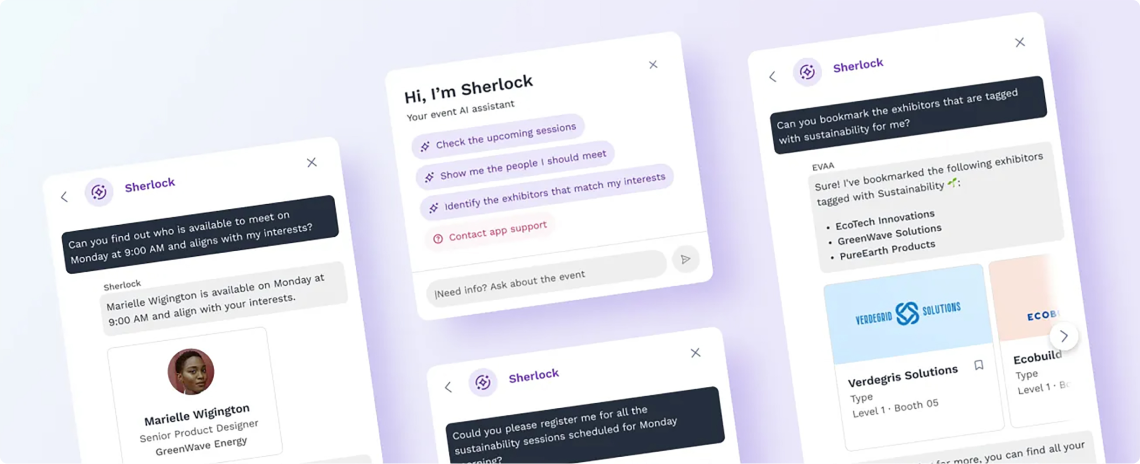
6. Personalized onboarding based on roles and permissions
Sherlock delivers contextual onboarding tailored to each participant's role, package tier, and visibility settings, automatically, without manual segmentation. A VIP sponsor should not have the same onboarding experience as a free attendee. An exhibitor with a premium package requires different guidance than one with a basic listing.
Manual segmentation consumes time and generates errors. Swapcard's AI handles onboarding automatically.
- Exhibitors get package-specific instructions on lead capture, booth optimization, and sponsorship features.
- Attendees get role-specific help navigating the agenda and booking meetings.
7. 70%+ App adoption vs. 30% Industry average
Swapcard events consistently reach 70% or higher mobile app adoption, which represents more than double the industry benchmark of 30-40%. A mobile event app delivers value only if people use it. High adoption means more data, better matchmaking, more exhibitor leads, and stronger engagement metrics to share with stakeholders.
Swapcard's AI-driven personalization makes the app essential. Attendees open it to see AI-curated recommendations, check personalized agendas, and receive smart meeting suggestions. The app becomes a feature they rely on, not an afterthought they will ignore.
8. AI learns and adapts in real time
Swapcard's AI recommendations improve continuously as participants use the platform—every session view, profile visit, and connection feeds back into the model.
Static recommendation engines produce the same results whether someone engages or ignores them. Swapcard's AI adjusts continuously based on actual behavior.
If an attendee ignores finance-related sessions, but consistently engages with sustainability content, the AI shifts recommendations accordingly, sometimes within hours. For the organizers, this means higher engagement throughout the event lifecycle, and not solely on day one.
9. Built for privacy and GDPR compliance
All Swapcard AI models are trained in compliance with European data protection regulations, and each event's data is isolated to prevent cross-contamination between communities.
Event data is sensitive. Attendee profiles, exhibitor leads, and networking behavior must be protected, both legally and ethically. Swapcard's AI architecture includes three essential safeguards:
- Community separation: your event data never trains models for other events
- Bias monitoring: a "light learning" approach detects and deactivates biased recommendation weights
- Transparency: every recommendation includes an explanation, so users understand why they see it
Trust drives adoption. Participants engage more readily with AI they trust, which ties directly into the data and security standards expected by enterprise organizers.
10. Model-agnostic architecture for continuous improvement
Swapcard's AI layer selects from multiple LLM providers (OpenAI, Gemini, Anthropic, Mistral, and Meta) based on the task and audience.
As the AI landscape continues to rapidly evolve, a model-agnostic approach ensures Swapcard always uses the most capable reasoning engine available, without waiting for vendor upgrades or platform migrations. And as AI technology improves, your events benefit automatically: no contract renegotiations, no re-implementations, and no downtime.

11. Dedicated AI research lab since 2022
Swapcard Lab is a dedicated team of researchers, product owners, and engineers focused exclusively on AI for the event industry, and it publishes its findings publicly.
While most event platforms license third-party AI and rebrand it, Swapcard built proprietary AI from the ground up, optimized specifically for events.
The lab organizes its research around three pillars:
- Matchmaking: people-to-people connections, session discovery, and automated meeting generation
- Large language models: a reduction in organizer workload and simpler attendee journeys
- Meaningful insights: engagement data turned into actionable intelligence
For Swapcard, this is a multi-year R&D commitment that directly improves product performance.
12. Two AI systems working together
Swapcard combines generative AI (Sherlock and Cortex for conversational assistance) with non-generative AI (GISMO for high-speed recommendations) to deliver both human-like interaction and industrial-scale performance.
This is crucial, as one cannot work for every task. Generative AI excels at natural language understanding and flexible, conversational answers. Non-generative AI excels at real-time, large-scale matching with strong privacy controls.
Sherlock answers questions like "Which sessions should I attend today?" with conversational, contextual, multilingual support. GISMO processes ten thousand attendee profiles in seconds to generate smart meeting recommendations that are fast, scalable, and privacy-first.
Together, the two systems cover every use case across the attendee journey.
13. Eight years of AI development, not a trendy rebrand
Swapcard has built AI for events since 2018. While many platforms added "AI" to their marketing in 2023 by wrapping ChatGPT in a chatbot widget, Swapcard has refined event-specific AI for nearly a decade, across natural language processing, recommendation algorithms, matchmaking logic, and engagement prediction models.
More than 25% of all platform interactions are now AI-driven, and that percentage continues to grow. For event organizers, this means a partner that understands AI deeply, not one that chases trends. This is the difference between AI that has been stress-tested across thousands of events and 7 million attendees, and AI that has been stress-tested across a marketing deadline.
14. Recommendations come with explanations
Every AI recommendation on Swapcard includes a transparent explanation: why this session, why this person, why this exhibitor. A suggested connection might surface because two attendees share an industry, mutual contacts, overlapping interests, or have attended the same events. A recommended exhibitor might be flagged because of a session the attendee just bookmarked or a profile they recently viewed. These annotations turn a generic "you might like" into a deliberate signal that the user can trust, dismiss, or refine by updating their preferences.
On the contrary, "Black box" AI erodes trust. When users do not understand why they see a recommendation, they ignore it, or worse, they distrust the platform. The cost of that lack of trust can be remarkably high: a single missed connection can mean a lost partnership or a lost lead. When recommendations feel arbitrary, people fall back on the inefficient defaults—wandering aisles, scanning every badge, choosing sessions by title alone.
Swapcard's AI is explainable by design. Attendees see explanations such as "We recommend this session because you bookmarked similar content and attendees with similar profiles rated it highly." The result is higher engagement, better feedback loops, and participants who feel in control.
15. Proven at the world's largest event
Swapcard AI has been tested and validated at some of the most demanding events in the world, including HLTH with twelve thousand-plus attendees. At the HLTH event, the platform delivered 91% active app usage versus a 35% industry average, generated almost thirty thousand total leads (an 18% year-over-year increase), and lifted average exhibitor contacts by 12% year-over-year.
These are not small pilots. These are mission-critical events in which AI had to perform flawlessly, and it did. Moreover, this reflects what happens when digital experience is treated as a long-term investment. With Swapcard, HLTH has strengthened engagement, supported exhibitors more effectively, and delivered measurable growth in connections and lead generation.
These are not small pilots. These are mission-critical events in which AI had to perform flawlessly, and it did. Moreover, this reflects what happens when digital experience is treated as a long-term investment. With Swapcard, HLTH has strengthened engagement, supported exhibitors more effectively, and delivered measurable growth in connections and lead generation.
Bonus: Swapcard's AI scales without performance loss
Swapcard's AI architecture works for events of all sizes, from five hundred-person association conferences to thirty thousand-person trade shows, without throttling performance or charging premium fees for AI access.
Some platforms claim AI features but limit them to larger contracts. Swapcard's AI is native to the solution and scales automatically based on event size and complexity.
Tier-specific results show the same pattern across every size category:
- Tier 1 (2,500+ attendees): 340% more leads per exhibitor
- Tier 2 (501 to 2,500 attendees): 143% more leads per exhibitor
- Tier 3 (1 to 500 attendees): 14% engagement lift
No matter the size, Swapcard’s AI adds value.
Conclusion: AI that delivers, not just promises
The difference between Swapcard's AI and "AI-powered" competitors comes down to one thing—results you can measure. Swapcard delivers:
- 340% more leads for exhibitors at the largest events
- 45% of networking triggered by AI recommendations
- 70%+ app adoption versus 30% industry average
- 40% of lead generation happening before doors open
- 100% exhibitor activation at optimized events
These outcomes are documented, repeatable, and backed by data from thousands of events worldwide.
When evaluating event platforms where AI is part of the conversation, ask vendors to show the data. Ask for case studies. Ask how long they have been building AI, and whether it is proprietary or licensed. Then compare those answers to what Swapcard has built since 2018.
Ready to see what AI can do for your next event? Schedule a live demo today or explore the full event engagement platform to discover more data-driven insights.
Frequently asked questions about AI for events
What Is AI for events?
AI for events refers to artificial intelligence technologies integrated into event platforms to automate matchmaking, recommend sessions and exhibitors, qualify leads, and assist attendees. In Swapcard's case, AI powers networking, exhibitor lead generation, and personalized support across the entire attendee journey, from registration to post-event follow-up.
How does AI improve exhibitor lead generation?
AI improves exhibitor lead generation by combining digital behavior and onsite signals into a single, qualified lead profile. Instead of raw badge scans, exhibitors receive context: booth visits, content viewed, meetings requested, and intent scores. Swapcard data shows up to 340% more leads per exhibitor at Tier 1 events when AI features are activated.
Is Swapcard's AI GDPR compliant?
Yes. Swapcard's AI is built for GDPR compliance, with community-level data isolation, bias monitoring, and explainable recommendations. Every event's data remains separate, and models never train across communities. The platform also holds SOC 2, ISO 27001, and PCI DSS certifications.
What is the difference between generative AI and non-generative AI on Swapcard?
Generative AI (Sherlock) handles conversational assistance, natural-language questions, and multilingual guidance. Non-generative AI (GISMO) powers high-speed recommendations and matchmaking at scale, which process ten thousand attendee profiles in seconds. Both systems work together to deliver the best of conversational and industrial-grade AI.
How do I measure event technology ROI with AI?
Measure event technology ROI by tracking lead volume, lead quality, exhibitor retention, app adoption, and revenue per attendee. Swapcard's analytics unify registration, engagement, and lead data into a single view, which makes it easier to prove ROI to exhibitors and stakeholders. Review the event ROI guide for a full roadmap.
Does AI replace event staff?
No. AI replaces repetitive tasks, not event staff. Sherlock handles routine FAQs—venue questions, schedule lookups, app troubleshooting—so your team can focus on VIP attendees, crisis management, and strategic troubleshooting. The goal is to extend your team's capacity, not reduce headcount, letting the same staff deliver a more responsive, higher-touch experience.


Join 12,000 subscribers and unlock industry secrets.
By submitting this form, you agree to receive periodic emails on insightful content related to events and our product, and in accordance with our Privacy Policy. You can, of course, change your preferences or unsubscribe at any time.

.svg)


.svg)
.svg)
.svg)
.svg)


