


Abstract Review Trends: What Conference Teams Should Expect in 2026
Your 2026 call for speakers will shape revenue long before the first badge prints. Most conference teams build an abstract review around committee convenience, then expect the finished agenda to carry the commercial weight of the event. That order is backwards. The abstract review trend worth planning for is not faster scoring. It is review decisions that continue to feed value after the event closes — into engagement data, sponsor reporting, and the next call for speakers.
The stronger approach is not just faster intake. It is a review model that connects speaker selection to event data, agenda planning, attendee behavior, and commercial outcomes — all in one place, rather than scattered across tools you reconcile by hand. That shift decides which upgrades deserve budget and which ones only look good on a screen.
Key Takeaways:
- Abstract review is becoming a data workflow, not just a committee task.
- Reviewer speed matters, but scoring consistency matters more when program quality is on the line.
- Standalone submission tools create data gaps between accepted sessions and event performance.
- Automation should improve triage, not replace human judgment or hide bias.
- Stronger evaluation criteria balance session quality, audience demand, and sponsor relevance.
- Program impact measurement should connect accepted sessions to attendance, engagement, meetings, and exhibitor ROI.
Why standalone abstract review breaks event performance
A standalone abstract review breaks event performance because it cuts program decisions off from the data that proves whether those decisions worked. A clean review queue can still produce an agenda that misses buyer intent, attendee demand, and sponsor value. In 2026, the real risk is not a slow review. It is a disconnected review.
.webp)
Administrative convenience is the wrong objective
Optimizing abstract review for administrative convenience is the wrong objective, because a smooth process can still produce a program that proves nothing. Speed and tidy queues feel like progress, but they do not guarantee that accepted sessions drive registration or support sponsors.
Picture a conference manager — call her Priya — at 5:40 p.m. on a Thursday. She exports a spreadsheet from her standalone submission tool, copies the reviewer notes into a second tab, and emails nine committee members to say that the final review is due. Three reviewers still have not scored their assigned abstracts. Two scored every proposal a 4 out of 5. None of the scores connect to registration segments, exhibitor categories, or the app data that the platform team will pull after the event. The process looks under control, but in reality, it is not connected to anything that proves the program worked.
Most abstract review trends focus on making life easier for administrators, and that matters—reviewers should not need five clicks to score one proposal. But a fast committee process means little if accepted sessions cannot drive registration interest or create the engagement that justifies a renewal conversation. The better question is about downstream performance: what will this session make attendees, exhibitors, and sponsors do before, during, and after the event?
This is a surface-versus-systems problem. Many teams upgrade what reviewers see — cleaner forms, nicer dashboards — while the underlying connections remain broken. The review tool still does not talk to registration, the agenda, or sponsor reporting. It looks finished, but the data goes nowhere.
Review gaps show up later as agenda gaps
Review gaps rarely show up during scoring. They appear later — when a highly rated session draws a thin crowd, or when a sponsor asks why their priority audience never made it into the program. By then, the schedule is published, speakers are confirmed, and rooms are locked.
For 2026, treat abstract review as the first draft of your engagement strategy. If your criteria only ask whether the speaker is credible and the abstract is well written, the committee will miss signals that matter just as much. Does the topic match registration demand? Does it support a track that exhibitors care about? Does it give attendees a clear reason to move from the session to a meeting or a booth? Those questions decide whether the program can prove its value after the event.
A fair concession: not every conference revolves around sponsors. Some association meetings prioritize member education, continuing education credits, or community leadership, and forcing commercial scoring on them would damage the program. Even then, accepted-session quality still needs to connect to outcomes such as attendance, session saves, ratings, and repeat participation. The review process should match the event's business model, not sit outside it.
If the review data cannot be used after acceptance, the workflow is not finished.
How to redesign abstract review around downstream metrics
These abstract review trends point to one redesign principle: build the process around the outcomes that the final agenda must influence. That means session quality, audience demand, sponsor relevance, reviewer consistency, and engagement you can measure. Review speed still matters, but it should never outrank decision quality. A fast process that produces weak programming just reaches the wrong agenda sooner.
Score consistency before speed
Score consistency matters more than reviewer speed, because uncalibrated scoring creates noisy acceptance decisions. Three reviewers can read the same abstract and see three different events inside it. One sees a strong technical session; another sees a flat lecture. Neither is automatically wrong. The trouble starts when the system treats those readings as equal without defining what each score means.
Reviewer calibration is the overlooked foundation here. Before scoring begins, decide what a top score looks like for each criterion and what should pull a score down. A five-point scale with no examples creates noise. The same scale with clear examples creates shared judgment. A simple rule helps: if two reviewers score the same abstract more than two points apart, send it for a brief calibration check instead of going straight to a decision.
Run a quick diagnostic before you change the workflow:
- Do reviewers agree on what "high audience relevance" means?
- Are sponsor-adjacent topics judged on educational value first?
- Does the committee know which tracks need more depth or fewer repeated formats?
- Are reviewer comments specific enough for a program lead to defend the decision?
- Can accepted sessions be mapped to post-event metrics later?
Once those answers are clear, a committee can move fast with confidence. Without them, speed only hides the problem. This is the step that would have saved Priya's Thursday night: the two reviewers who scored everything a 4 were never given a shared definition of what a 4 means. The goal is not to make reviewers work harder. It is to remove avoidable disagreement before fatigue sets in.
Separate session quality from audience demand
Separate session quality from audience demand, because combining them into a single score obscures the trade-offs that matter most in agenda planning. A proposal can be well written and credible while serving an audience too narrow for a main-stage slot. Another can be timely and commercially relevant, but needs a stronger speaker or a better format. One overall number erases those differences.
Now score at least three dimensions on their own: content strength, audience demand, and event fit. Content strength covers the speaker, topic clarity, and learning value. Audience demand draws on registration segments, saved topics, past attendance, and search behavior (when available). Event fit looks at track balance, sponsor relevance, and whether the format serves the event's goals. Separating them gives program leaders room for editorial judgment instead of pretending every call is purely numerical.
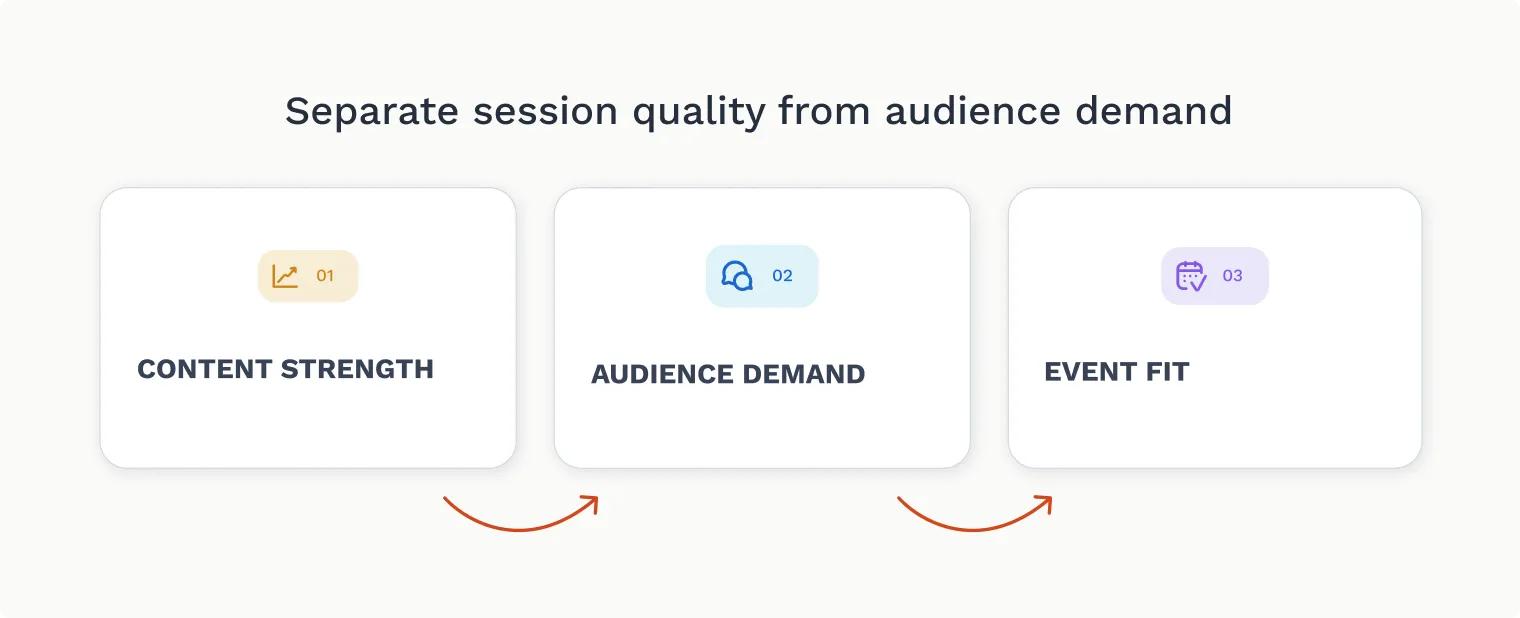
Scoring these dimensions separately lets you place a session instead of just accepting or rejecting it. A proposal that scores high on content but low on demand might fit a workshop or an on-demand track. If demand is high but content is low, ask for revisions or pair the speaker with a strong moderator. If sponsor relevance is high but educational value is weak, the answer is no — or a clearly labeled sponsored slot. That last distinction protects trust.
One trade-off to note: adding more criteria can tire reviewers if the form grows too long. Keep only the fields that will actually change a decision. If a score won't move the outcome, cut it. Five useful fields beat a 20-field form nobody trusts by the third scoring session.
Treat sponsor relevance as a signal, not a veto
Sponsor relevance should inform abstract review, not control it. The common mistake is pretending commercial context has no place in programming, then letting it creep in through side conversations anyway. The cleaner move is to make sponsor relevance visible as one signal while educational value and audience fit remain priorities.
For trade shows, B2B conferences, and association events with exhibitor programs, session selection affects exhibitor ROI more than many organizers admit. A cybersecurity sponsor cares whether the agenda attracts security buyers. A medtech exhibitor cares whether procurement teams have a reason to attend nearby sessions. That does not mean sponsors choose the agenda. It means organizers need a way to see whether the program gives commercial partners a fair path to the right conversations.
A useful rule is to separate sponsor relevance from sponsor influence. Relevance asks whether a session theme connects to exhibitor categories or buyer interest. Influence is a sponsor changing an editorial outcome without a clear label. The first is legitimate agenda intelligence. The second erodes trust.
Internal alignment matters here too. Education teams may resist commercial signals because they worry about program integrity, and that concern is fair. Commercial teams may push for revenue-friendly themes, and that pressure is real. The fix is not to silence either side. It is to define where commercial relevance belongs in the scoring model and where it does not.
For organizers tracking broader events trends 2026, this is one of the clearest shifts: programming is no longer only a content decision. It is part of the event's revenue and engagement architecture.
Use automation for triage, not judgment
Use automation for triage, not judgment: let it reduce sorting work and flag risks, but keep final program decisions with people. Artificial intelligence (AI) can group submissions by topic, catch incomplete entries, route abstracts to the right reviewers, and surface repeated themes across hundreds of proposals. That saves time where humans add the least value.
Bias creeps in when automation starts ranking speakers or predicting "quality" without visible criteria. A well-known speaker may score higher on name recognition alone. A new topic may be penalized simply because the system has less history on it. The answer is not to reject AI. It is to decide which tasks are safe to automate and which need human judgment.
Use a two-lane rule. Automate the work that organizes the queue and exposes patterns. Keep people responsible for anything that affects speaker opportunity, editorial balance, or audience representation. Automation can flag that 38% of submissions fall into one track while only 6% support a strategic growth theme. The committee then decides whether that gap reflects real demand or weak outreach.
Transparency matters as much as speed. Reviewers should know why an abstract was routed to them and what data shaped the process. Speakers do not need a full scoring audit, but they deserve a process you can explain without wincing. If you cannot explain how automation affected a submission, it is not ready for high-stakes review.
Feed agenda planning with behavioral signals
Feed agenda planning with behavioral signals, because abstracts only show what speakers want to present — not what attendees will actually value. Registration and engagement data show the second half. The gap between the two is where strong programs get built.
Start simple. Look at which attendee segments are registering early, which topics show up in profile data, which exhibitor categories are drawing interest, and which themes appear in pre-event searches or saved content. These signals should not replace editorial judgment. They should pressure-test it. If the committee loves a track the registration data does not support, the team can decide whether to reposition it, cut slots, or promote it differently.
At larger conferences, the payoff grows. A session theme that attracts saves before the event may deserve a bigger room or a stronger push notification. A topic that draws the right audience may support a hosted-buyer route or a sponsor package. A track with weak early interest may need new copy or fewer prime slots. Teams that connect review to event data can make these changes while there is still time to act.
Here is a budget rule worth keeping: fund integrations before cosmetic reviewer upgrades. A nicer submission portal that leaves accepted sessions cut off from registration, agenda, app, and reporting data only improves one corner of the process. A connected platform that lets review decisions inform the agenda, attendee discovery, and post-event reporting is redesign worth defending.
For teams evaluating conference management software, abstract review should be part of the platform discussion, not a separate purchase. The accepted program is worth more when its data can flow into engagement and reporting without another manual export.
Measure accepted sessions beyond room attendance
Measure accepted sessions by what they cause, not just whether the room filled. Attendance is useful but shallow on its own. A session that draws 400 people but produces no saves, questions, or meetings may matter less than a 90-person technical session that creates qualified conversations.
Build measurement in three phases. Before the event, track which accepted sessions get saved, shared, or added to personal agendas. During the event, track attendance, ratings, questions, and related exhibitor engagement. After the event, compare session themes against meetings booked, leads captured, and content viewed. Not every metric fits every conference, but every event needs a clear link between programming and performance.
It helps to sort session impact into three buckets:
- Audience value: saves, attendance, ratings, questions, and repeat attendance.
- Commercial value: sponsor alignment, exhibitor visits, meetings, and lead activity.
- Program value: track balance, format variety, topic coverage, and year-over-year demand.
The best review changes make this measurement easier. If your criteria included audience demand and sponsor relevance, you can later compare those assumptions against real behavior. If reviewer notes captured why a session was accepted, you can see whether the reasoning held up. This is also the moment Priya's spreadsheet finally pays off — or fails to. Scores tied to registration segments and exhibitor categories become a post-event report. Scores stranded in a standalone tool become a recap nobody trusts.
This also changes the renewal conversation. Sponsors and exhibitors no longer have to take it on faith that the agenda brought the right audience. You can show which topics drew attention, which sessions shaped behavior, and where engagement turned into qualified interest. That is where programming starts supporting exhibitor sponsor tools — not as a sales add-on, but as part of the event's value chain.
When accepted sessions need to connect to saves, meetings, lead activity, and sponsor evidence.
Once teams know what the review workflow should connect to, the next question is practical: can their event system actually support that connection?
How Swapcard connects sessions to revenue data
Swapcard connects abstract and speaker workflows to the rest of the event so accepted sessions can shape registration, engagement, networking, and exhibitor value. The goal is not to replace the program team's judgment. It is to keep review, agenda planning, and event performance in one connected flow instead of separate tools.
When accepted sessions need to align with real attendee behaviors—such as session bookmarks, networking meetings, lead activity, and sponsor engagement—the review process must rely on program data that extends beyond the review committee.
Speaker intake becomes part of the event record
Swapcard's Speaker & Abstract Management gives organizers one place to collect, review, and manage submissions and abstracts. The Call for Papers workflow supports custom fields, deadlines, and category routing, and review queues allow comments and decision tracking. For 2026 intake, that matters because the accepted program should not live in a separate tool that loses context the moment sessions move into the agenda.
The value grows after selection. Registration, the Event Builder and branded app, push and calendar reminders, polls, Q&A, ratings, and AI matchmaking all generate signals about how attendees respond to the program. Attendees save sessions, get reminders, ask questions, and discover relevant people or exhibitors. Together, that shows whether your session choices actually supported engagement and exhibitor ROI.
This fits multi-track conferences, association annual meetings, and trade shows where programming has to do more than deliver education. It is less relevant for a single-session webinar or a small private gathering with no exhibitor or networking layer. A connected review approach earns its budget when session decisions need to feed the rest of the event.

Engagement and lead data close the program loop
Swapcard also links programming to commercial outcomes through AI Matchmaking, Smart Meetings and Hosted Buyer, Lead Capture, and the Exhibitor Lead Center. These matter because accepted sessions often shape who attends, what they save, and which exhibitors they find. In a B2B event, a session is not just content. It is a demand signal.
Verified results show why the connection pays off. At Game Developers Conference, organizers supported 28,000+ attendees, 1,000 speakers, and 330 exhibitors — with 32,000 active app users, 400,000 messages, 22,000 meetings, and 24,000 exhibitor bookmarks. The point is not that every event needs those numbers. It is that agenda, engagement, meetings, and exhibitor activity become far more useful when you measure them together.
Customer language points to the same need. As one organizer put it, "Using Swapcard for our exhibitors is really important to maximize their return on investment." Another said the data integration across business units "has helped my team save 2 weeks of work per event." For teams tying abstract review trends to 2026 budget, those outcomes matter more than a prettier scoring screen.
Build a 2026 review process that proves the program worked
The 2026 abstract review process should be judged on whether it improves the event — not on whether it makes committee admin look tidy. The abstract review trends worth your budget are the ones that connect review design, evaluation criteria, data integration, automation, agenda planning, and impact measurement into one operating model.
You do not have to rebuild everything at once. Start with the changes that actually shift downstream decisions: clearer reviewer calibration, separate scores for session quality and audience demand, transparent AI triage, connected event data, and a post-event loop that checks your acceptance assumptions against real behavior. Cosmetic upgrades can wait.
Done well, this gives you a defensible answer when speakers, sponsors, boards, and attendees ask why the program looks the way it does. It also gives your next call for speakers a better starting point. Among all the abstract review trends to plan for, this is the one that lasts: abstract review should no longer stop at acceptance. It should feed the agenda, the attendee journey, and the proof of value after the event closes.

Blessing Lola A.
Senior Content Marketer
Leads content strategy and execution at Swapcard across guides, articles, and event materials, using performance data and AI-powered tools to sharpen messaging and scale output.





Join 12,000 subscribers and unlock industry secrets.
By submitting this form, you agree to receive periodic emails on insightful content related to events and our product, and in accordance with our Privacy Policy. You can, of course, change your preferences or unsubscribe at any time.



.svg)

.svg)
