


Your post-show dashboard can be full of green arrows and still give leadership no reason to defend the next budget. Event ROI becomes credible only when event teams connect pre-agreed qualified buyer interactions to pipeline or revenue. App activity and badge scans still matter, but they show interest rather than commercial return. A leadership-ready scorecard follows each qualified contact into the customer relationship management (CRM) record and shows how that interest progressed after the event.
Leadership confidence comes from a scorecard that connects qualified ideal customer profile (ICP) contacts and booked meetings to CRM opportunities. That requires clear qualification rules, joined data, and named follow-up ownership. With those pieces in place, event teams can show commercial progression rather than another activity dashboard.
Key takeaways:
- Define event ROI around the commercial outcome leadership evaluates
- Treat registrations, scans, and content views as intent signals, not revenue proof
- Agree on ICP fit and buying intent before registration opens
- Connect event identity, engagement context, and CRM attribution
- Assign follow-up owners and report meetings, opportunities, pipeline, and revenue
Stop reporting reach and define qualified outcomes
Event ROI becomes credible when marketing defines a qualified commercial outcome before the trade show begins. Registrations and badge scans can indicate interest, but leadership evaluates meetings, opportunities, pipeline, and revenue. The first job is deciding which of those outcomes the event must create.
Engagement signals show interest, not return
A registration confirms that someone intended to attend. An app login shows activation, while a session bookmark points to an area of interest. Even a booth scan only proves that two people exchanged information at a particular moment. None of these actions confirms ICP fit, buying authority, or commercial progression.
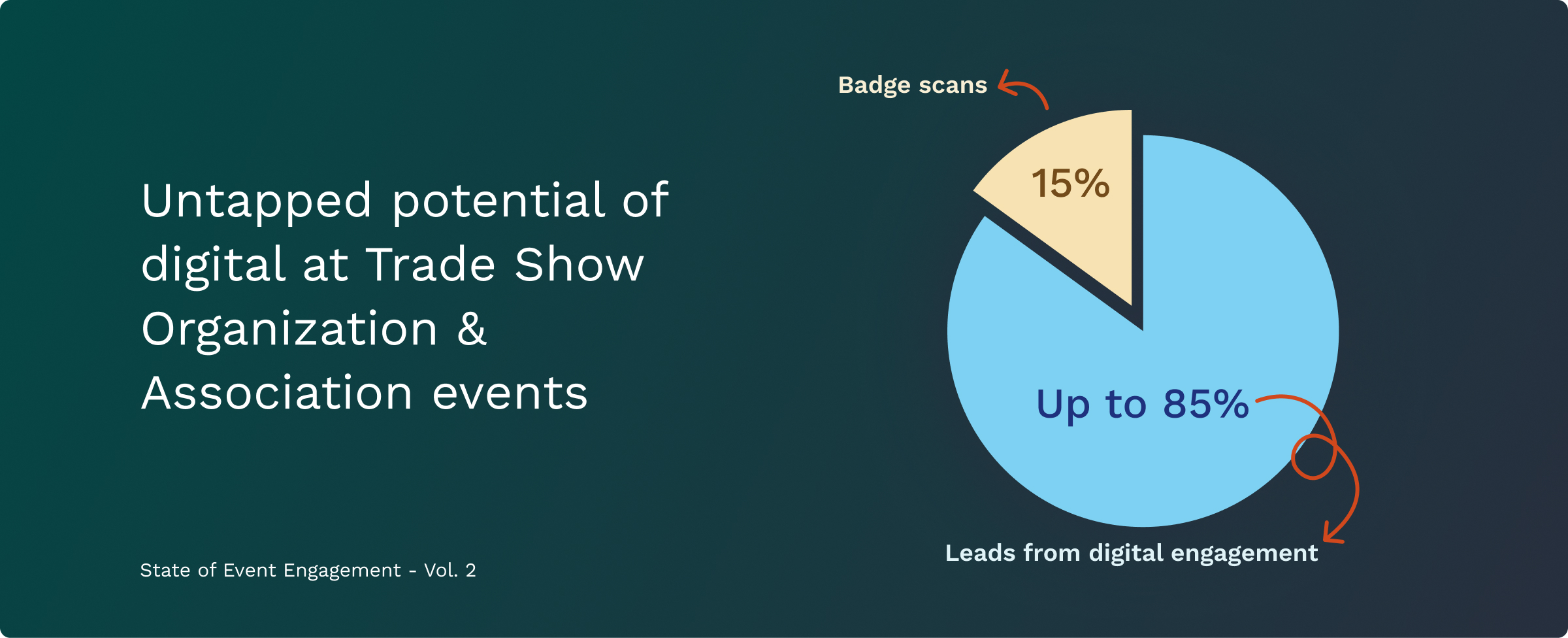
In Swapcard's event engagement benchmarks report, up to 75% of leads were generated outside traditional badge scanning. That finding strengthens the case for collecting first-party engagement data across the event journey. It does not turn every interaction into pipeline. Engagement data is the show-floor wayfinding layer: it shows where buyer interest moved, but it does not prove that interest reached a commercial destination.
Reach still matters. It can reveal audience health, content relevance, and potential demand. Its limitation is equally important: reach belongs near the start of the measurement chain, not at the end.
Separate organizer economics from exhibitor pipeline
Organizer economics and exhibitor pipeline answer different questions, so they need separate scorecards. Organizer leadership may evaluate event revenue, margin, sponsor renewals, and exhibitor retention. An exhibiting company will usually evaluate qualified contacts, booked ICP meetings, and pipeline progression.
Confusing the two creates misleading event ROI claims. A sold-out trade show may perform well for the organizer while producing a weak pipeline for exhibitors. The reverse can also happen when a focused conference creates strong buyer conversations despite modest attendance. Leadership must know what return the budget was expected to produce.
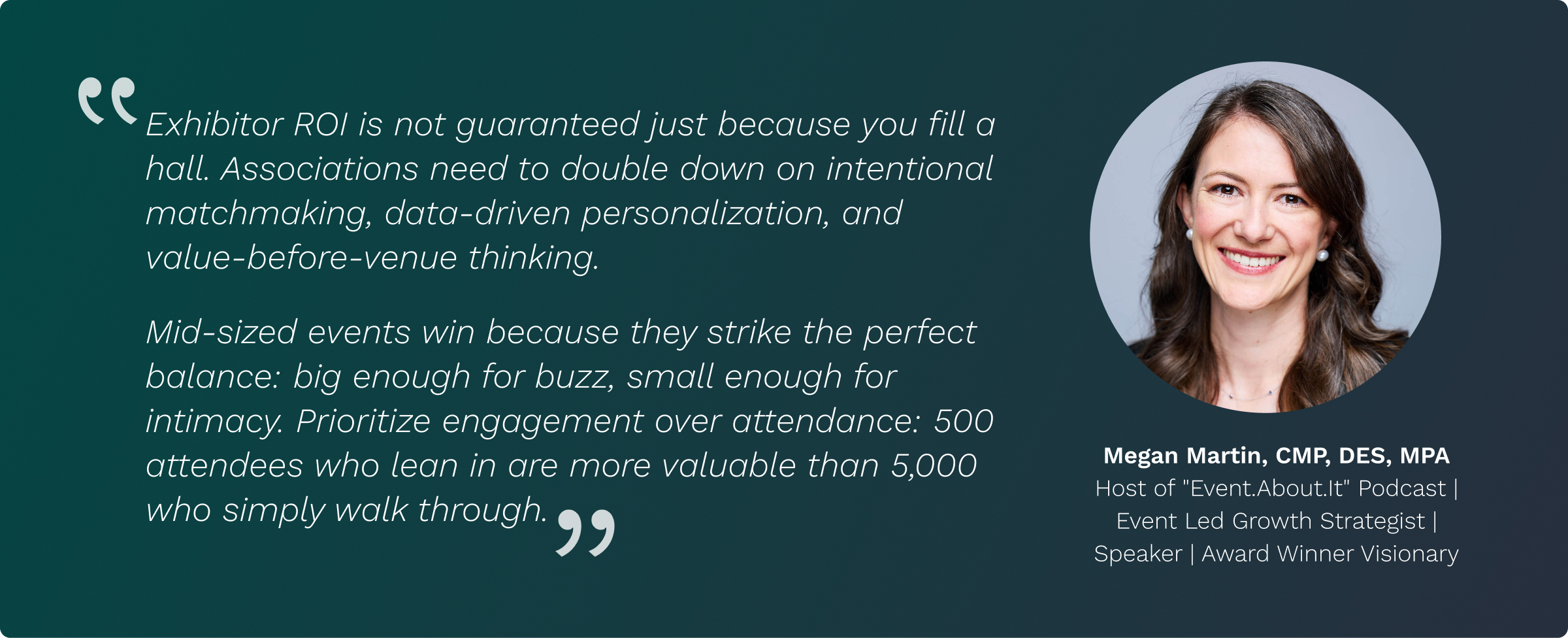
A useful event ROI framework starts with the budget owner and works backward from the decision that person must make. For an organizer, the decision may concern portfolio investment or exhibitor renewal risk. For an exhibitor marketing lead, it may concern whether the company returns next year. The outcome determines the scorecard.
Fix the qualification standard before registration opens
Would your sales team book a discovery call off this contact today, or would they ask for more? That single question exposes whether a lead is qualified or just scanned. Lead qualification must combine ICP fit with evidence of buying intent. Job title alone is not enough, and neither is a booth visit. Marketing and sales need to agree on the account traits, buyer roles, intent signals, and next actions that make a contact commercially relevant.
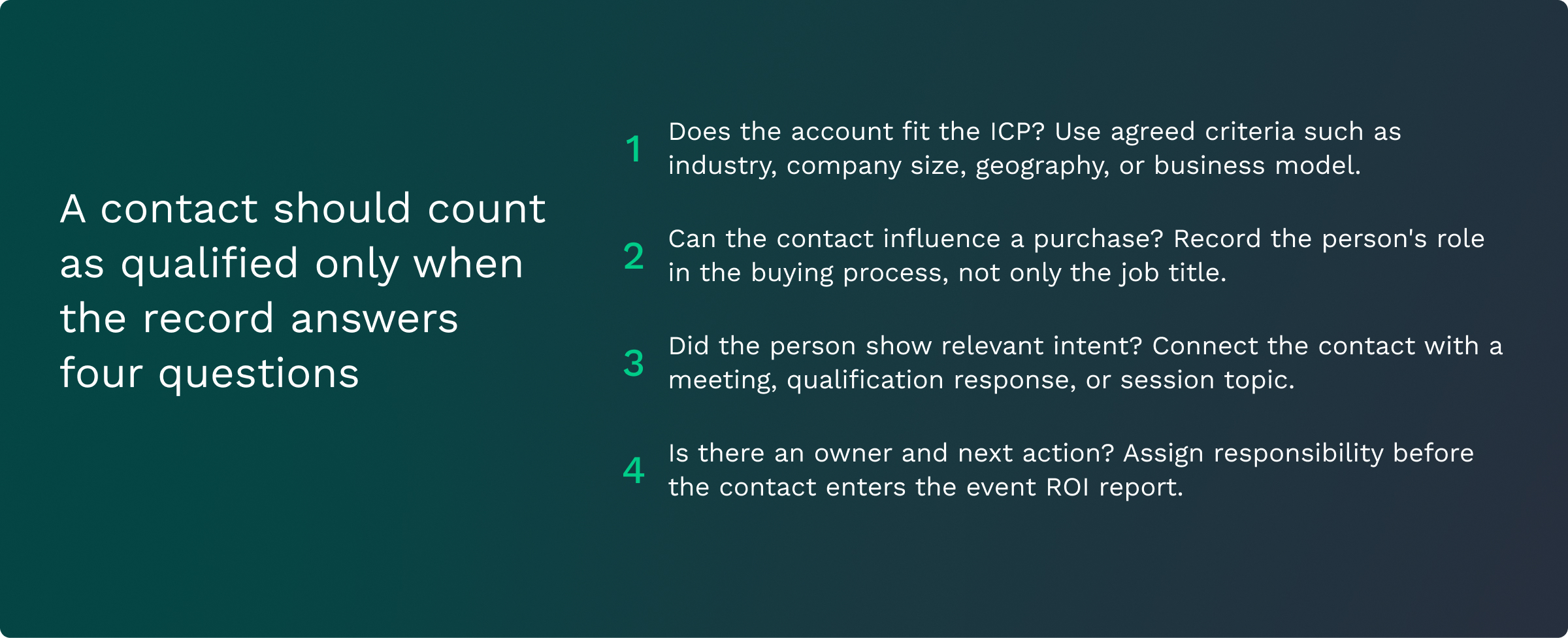
A contact should count as qualified only when the record answers four questions
- Does the account fit the ICP? Use agreed criteria such as industry, company size, geography, or business model.
- Can the contact influence a purchase? Record the person's role in the buying process, not only the job title.
- Did the person show relevant intent? Connect the contact with a meeting, qualification response, or session topic.
- Is there an owner and next action? Assign responsibility before the contact enters the event ROI report.
If sales would reject the contact without another discovery call, marketing should not present it as qualified pipeline. A booked meeting also needs a standard, such as buyer acceptance, ICP fit, and confirmed attendance. Organizers comparing these fields against their current scorecard can use Swapcard's connected event data model as one reference point.
Once the qualification is fixed, the next task is preserving each buyer's identity and context across the full event journey.
Unify event and CRM data to build credible attribution
Credible attribution depends on joining registration, meeting, and CRM records around one person and company. Without identity resolution, teams count the same buyer multiple times or lose the path from interest to revenue. Joined data turns scattered actions into an evidence chain.
Audit identity gaps before selecting an attribution model
Identity resolution matches records that belong to the same person or company across different systems. The process sounds technical, but the first audit is practical. Event teams need to follow one test contact from registration through the mobile app, onsite lead capture, meeting activity, and the CRM. Any broken handoff marks a reporting gap.
Duplicate email addresses are only one problem. Personal email use, inconsistent company names, and missing CRM account IDs can split one buyer into several profiles. Having found those gaps, organizers can decide which field acts as the primary identifier and where corrections happen. Attribution rules will not fix unresolved identity.
Before building the scorecard, check:
- Can one attendee be traced from registration to onsite activity?
- Can the attendee record connect to the correct company account?
- Do meeting and lead capture records carry timestamps and event IDs?
- Can the CRM distinguish event-created contacts from existing contacts?
- Does every opportunity retain the relevant event campaign or interaction reference?
A "no" identifies missing data, not poor performance. That distinction matters because leadership should never receive a zero where the actual answer is unknown.
Rank signals by commercial weight
A scan and an accepted buyer meeting do not carry equal commercial value. Both deserve capture, but only one shows that a qualified buyer agreed to spend time with a seller. Signal hierarchy prevents large volumes of low-intent activity from overshadowing fewer actions that carry stronger buying intent.
In one Swapcard-documented association trade show of 1,800 participants, 893 meetings were planned in advance, and 60% of leads received the highest quality score. The meeting and quality data gave organizers more useful evidence than participant totals alone. It also gave exhibitors a clearer basis for follow-up.
The hierarchy keeps engagement in its correct role: evidence that supports qualification and conversion. High activity with no meetings or opportunities points to a conversion gap, not proven event ROI.
Separate sourced pipeline from the influenced pipeline
Sourced pipeline begins when the event creates a net-new commercial opportunity. Influenced pipeline already existed but advanced after a meaningful event interaction. Combining both into one figure inflates the event's contribution and makes CRM attribution difficult to defend.
A practical rule is to classify pipeline as sourced only when the opportunity was created after the first qualified event interaction and no active sales motion existed beforehand. Existing opportunities belong in influenced pipeline when a relevant meeting, session, or exhibitor conversation contributed to progression. Records without a resolved identity or timestamp stay in engagement reporting until someone validates them.
Multi-touch attribution cannot prove causality with complete certainty. That limitation is real, especially in long sales cycles with several channels involved. Consistent rules still give leadership more confidence than selective credit assigned after revenue appears. The standard must apply to every event and every opportunity.
For each attributed opportunity, retain the event name, first interaction date, qualification status, meeting record, opportunity creation date, attribution type, and current pipeline stage. Those fields give finance and sales operations enough evidence to scrutinize the claim.
Set time windows before the first scan
Attribution windows should reflect the company's normal sales cycle, not the date when reporting begins. If a typical opportunity takes 90 days to emerge, a 90-day sourced-pipeline window is reasonable. A complex enterprise sale may require a longer influenced-pipeline window. The rule needs agreement before the show.
Multi-touch credit needs the same discipline. When leadership has not approved fractional credit, keep sourced and influenced pipeline separate rather than inventing a percentage split. A session view may support an opportunity, while a scheduled buyer meeting carries greater weight. The scorecard can show both signals without pretending they contributed equally.
Event teams should record three dates: first event interaction, opportunity creation, and revenue close. Those dates reveal pipeline velocity and prevent an old opportunity from being recast as event-sourced revenue. They also allow leadership to compare events using the same commercial clock.
A Swapcard walkthrough can show how joined interaction records support that requirement before organizers finalize their own attribution rules. The technology matters, but the agreed definitions still come first.
How to preserve lead context after an event
Generic nurture treats every scan as the same lead, which strips away the reason a buyer engaged. Contextual outreach starts with the interaction itself. A follow-up can reference the buyer's stated problem, the session viewed, the exhibitor saved, or the meeting topic discussed onsite. That context is the difference between a message a buyer remembers and one they delete.
The same Swapcard benchmark analysis found that one-third of inbound event leads received no follow-up. Missing ownership is a major cause. Set the response speed by intent level: high-intent contacts should receive personal outreach within one business day, while lower-intent signals can enter a relevant sequence within three business days. Speed matters because the buyer's memory of the conversation fades quickly.
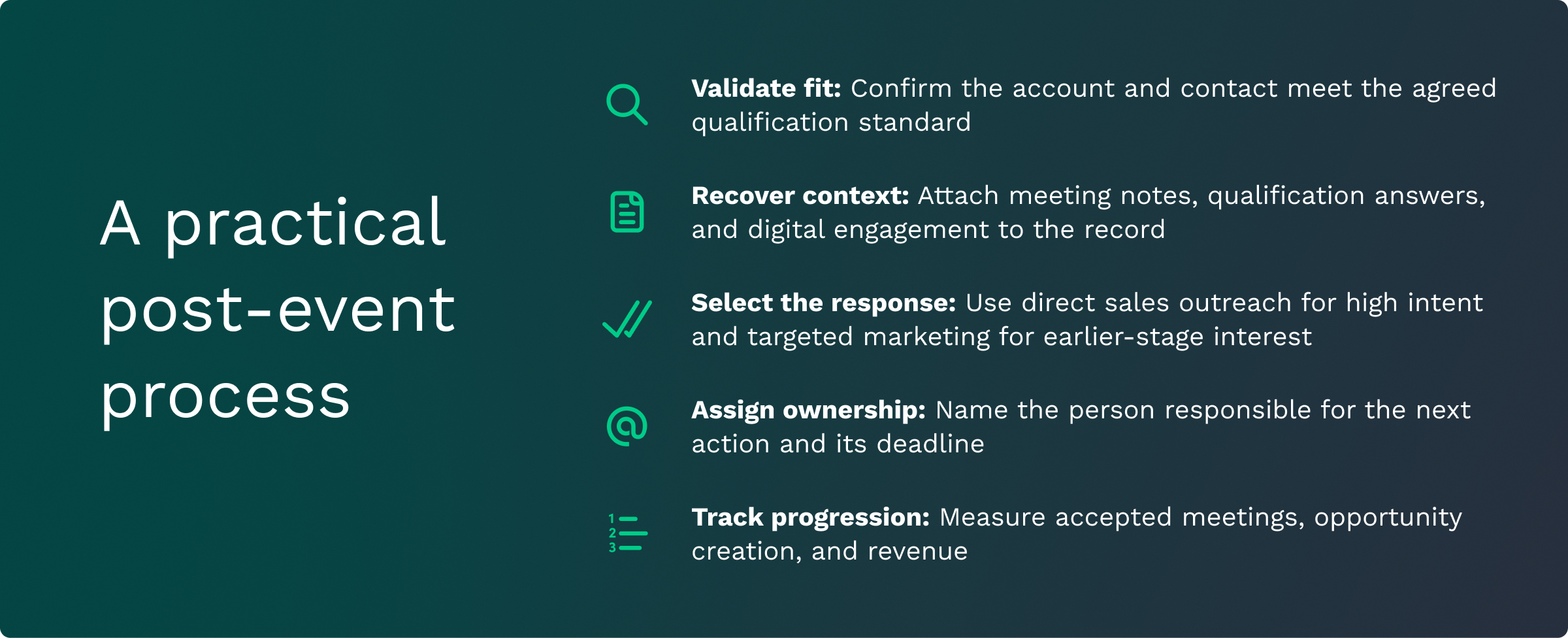
Effective exhibitor lead generation depends on that handoff. More contacts will not improve event ROI when the follow-up loses buyer context.
Who should own event ROI reporting data
Every metric needs one owner and one system of record. Event marketing can own engagement quality and campaign definitions. Sales owns opportunity progression, while revenue operations or marketing operations governs CRM attribution. Shared responsibility without named accountability usually leaves records untouched.
The event platform should hold registration, app behavior, meetings, and onsite lead capture. The CRM should remain the source of truth for opportunities, pipeline stages, and revenue. Marketing automation can run follow-up sequences, but it should receive qualification context rather than a flat list of scanned badges. Each system has a clear job.
Before the event, document:
- Qualification owner: Approves ICP and intent criteria
- Data owner: Resolves duplicate or incomplete participant records
- Follow-up owner: Accepts qualified contacts and completes the next action
- Attribution owner: Applies sourced and influenced pipeline rules
- Reporting owner: Produces the leadership scorecard and records data gaps
A leadership-ready scorecard starts long before the final dashboard. It depends on agreed definitions, connected records, and named commercial ownership.
How Swapcard connects event signals to revenue
Once the scorecard logic is defined, the next question is whether your event system can preserve the data needed to support it.
Swapcard supports the measurement model by keeping registration, meetings, and lead activity connected throughout the event lifecycle. Organizers can preserve the context behind each interaction instead of rebuilding it from CSV files after the show. The CRM still owns opportunity and revenue reporting.
One participant record carries context forward
Swapcard connects registration data, meeting activity, and lead capture into one participant record. Registration establishes the participant profile. App behavior and meeting signals add evidence of buyer interest, while badge scans, Booth QR interactions, and qualification responses feed into the exhibitor's lead record.
Where manual CSV reconciliation loses context between handoffs, joined event records preserve the path from first interaction through follow-up. Organizers gain a clearer picture of who engaged and whether that activity produced a qualified commercial action. Exhibitors receive context for follow-up instead of an isolated contact file.
Lead intelligence supports faster commercial follow-up
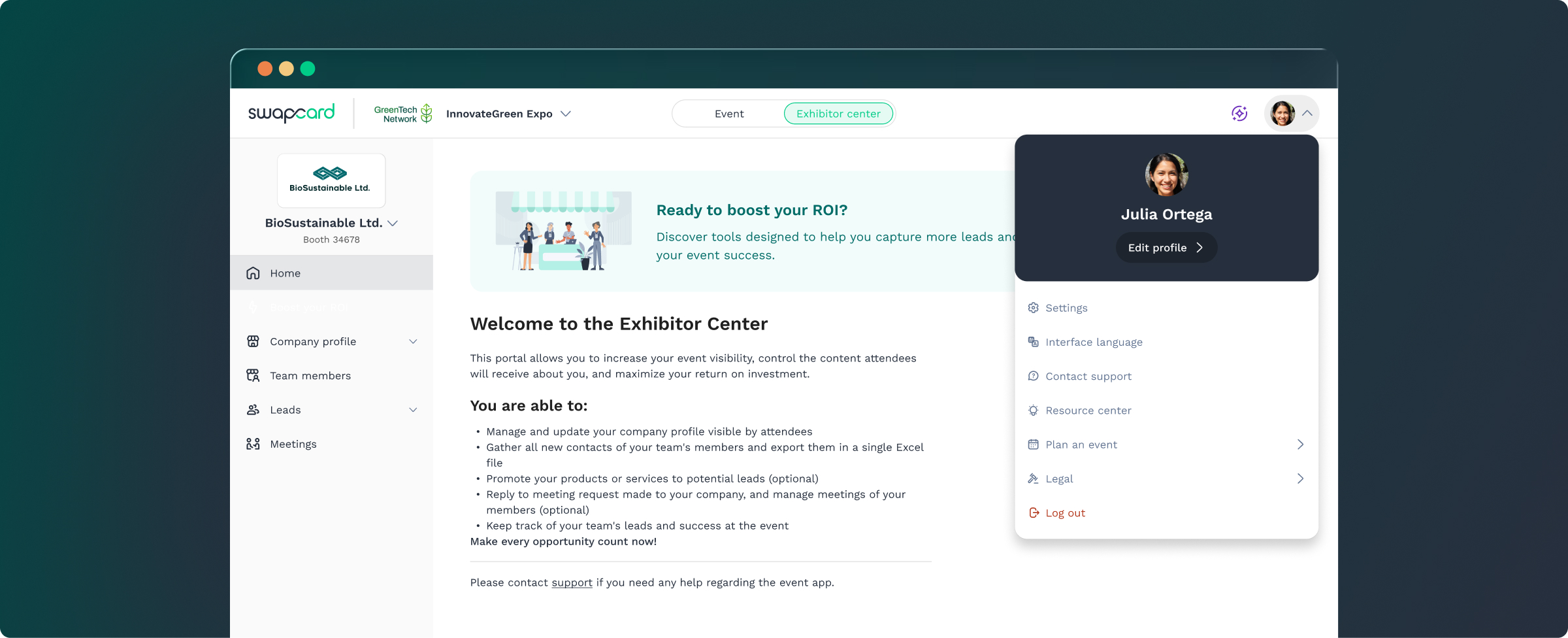
The Exhibitor Lead Center combines leads from scans, meetings, and AI recommendations in one inbox. Each lead can include attendee profile data, scan context, and a qualification score. Lead Qualification forms allow booth teams to record need, timing, and follow-up priority while the conversation is still fresh.
A connected event record gives sales judgment, CRM attribution, and post-event outreach better input to work from. Organizers can report the path from registration through qualified meeting and lead capture, while exhibitors can move relevant records into their commercial workflow with the context intact. Organizers replacing manual CSV reconciliation with joined event records can get started with Swapcard by mapping the current signal chain and identifying where identity or context disappears. Better event ROI reporting begins at those broken handoffs.
Report event outcomes that leadership can trust
Leadership-ready event ROI reporting shows commercial progression from qualified contact to meeting, opportunity, pipeline, and revenue. It separates organizer economics from exhibitor outcomes, distinguishes sourced from influenced pipeline, and identifies missing data rather than hiding it inside reach totals.
The final scorecard should show the agreed outcome, result, owner, system of record, attribution rule, and reporting window. Registrations and app activity can remain as supporting indicators, but they should never sit beside revenue as if they prove the same thing. When organizers connect buyer quality, interaction context, and sales progression, event investment becomes easier to defend, and renewal decisions become easier to make.
FAQs
How do I connect event engagement to revenue using Swapcard? To connect event engagement to revenue with Swapcard, start by ensuring all participant interactions are logged in the platform. Use the Exhibitor Lead Center to capture leads from badge scans, business card scans, and meetings. Make sure to assign ownership for follow-up actions and track each lead's progression through your CRM. This way, you can clearly show how engagement translates into qualified meetings and ultimately revenue.
What if my event registration forms are causing drop-offs? If you're seeing drop-offs in registration, consider simplifying your forms. Use Swapcard's conditional logic features to tailor the questions based on attendee type, which can reduce the number of fields seen by each user. Also, enable abandoned registration tracking to follow up with those who started but didn't complete the process. This can help recover potential attendees who might have been interested.
Can I track attendee interactions during the event? Yes, you can track attendee interactions during the event using Swapcard's integrated tools. Utilize the app to capture engagement data such as session attendance, booth visits, and content views. This data can help you understand attendee behavior and preferences, allowing you to tailor follow-up strategies post-event to maximize conversion rates.
When should I start promoting my event to maximize attendance? Start promoting your event at least six weeks in advance. This gives potential attendees enough time to register and plan their visit. Use Swapcard's 365 Event Hub to keep the audience engaged with pre-event content and updates. Engaging your audience early helps build anticipation and can lead to higher attendance rates.
Why does follow-up ownership matter after an event? Follow-up ownership is crucial because it ensures that leads are managed effectively after the event. Assigning specific team members to follow up on qualified leads captured through Swapcard helps maintain momentum and ensures timely outreach. This can significantly improve the chances of converting leads into opportunities and revenue.

Bhavya Sharma
Senior Content Marketing Manager
Shapes content strategy across the funnel at Swapcard, from awareness messaging to thought leadership, driving B2B SaaS growth through research-backed storytelling.



Join 12,000 subscribers and unlock industry secrets.
By submitting this form, you agree to receive periodic emails on insightful content related to events and our product, and in accordance with our Privacy Policy. You can, of course, change your preferences or unsubscribe at any time.



.svg)

.svg)
