


Abstract Review Process Checklist: Steps to Avoid Common Submission Errors

Most abstract review problems start before a reviewer reads a single submission. On the day after the deadline, a conference manager opens three spreadsheets and finds that 18 abstracts have no topic category. The program team is already chasing authors and patching data before the review has even begun. Reviewers will inherit those gaps unless the intake workflow stops them first.
A review committee should judge content quality, not repair inconsistent submissions. Organizers need one controlled workflow that validates data at intake, assigns ownership for exceptions, and keeps accepted records connected through to speaker management and session scheduling. With that structure in place, event teams can audit each decision without rebuilding the history from email threads.
Key takeaways:
- Prevent incomplete submissions before abstracts reach reviewers
- Keep submission, eligibility, scoring, and decision records connected
- Match reviewers by expertise while controlling workload and conflicts of interest
- Define scoring thresholds, tie rules, and override ownership before review opens
- Move accepted abstract data into speaker and agenda workflows without manual re-entry
Why incomplete abstracts keep reaching your reviewers
Submission errors trace back to fragmented controls. When forms, scoring sheets, and author communications sit in separate systems, no one can see which checks have been completed. The review committee becomes the final quality gate for problems that intake rules should have blocked.
Fragmented files hide ownership
A typical conference workflow starts with an online form, moves into a spreadsheet, and then splits again into reviewer emails or shared folders. One coordinator updates the author name. Another corrects the topic category. A third person assigns reviewers using a separate worksheet, with no clear record of which version is current.
By the time scoring begins, the event team has several versions of the same abstract. A reviewer may assess an outdated file while the program manager works from a corrected record. When an author asks why a submission was rejected, reconstructing the decision means searching email, spreadsheets, and meeting notes. That is administrative archaeology, with staff digging through layers of records to work out what happened.
Organizers evaluating broader application management controls can apply the same principle to abstracts: intake, review status, and decisions need one traceable record.
Reviewers become unpaid data cleaners
Reviewers lose valuable time when they must decide whether an incomplete abstract is eligible, whether an author belongs to the right track, or whether a missing disclosure should block scoring. Asking subject experts to resolve form errors is a poor use of the expertise organizers recruited them to provide. It also results in inconsistent treatment because each reviewer fills in the gaps differently.
Manual review still has merit. Program chairs understand the nuance that automated rules cannot judge, especially around emerging topics or unusual session formats. The mistake is using human judgment for every check. Eligibility rules should handle predictable conditions, while named owners manage the exceptions that genuinely require judgment.
A controlled process moves those checks upstream, leaving reviewers to assess relevance, quality, and audience value.
How to build a controlled abstract review process
A controlled abstract review process uses one record, clear ownership, and defined rules from submission through acceptance. The goal is to separate checks a system can enforce from judgments that belong with reviewers and program leaders.
Audit every handoff before changing the workflow
A useful audit compares what the process says should happen with what staff actually do. Start with one recently completed review cycle and trace several abstracts from submission to final agenda placement. At each handoff, record the system used, the person responsible, and any information copied by hand. Repeated copying usually reveals where errors enter.
The audit should examine evidence, not recollection. Program teams often remember the major decision meeting but overlook the small corrections made through email during the weeks before it. Those corrections matter because they show which controls are missing. Review five records together:
- The original submission and any later edits
- The eligibility decision and exception notes
- The reviewer assignment history
- The completed scores and reviewer comments
- The final decision, author notice, and session record
If the team cannot connect all five without searching several locations, the abstract review process lacks a reliable system of record. That finding should shape the redesign.
Design submission forms around decisions
Every required field should support eligibility, reviewer routing, evaluation, or downstream event operations. Forms become difficult when organizers ask for information because someone might use it later. Authors then rush through fields, enter placeholders, or abandon submissions, while the event team collects data it never uses.
A stricter design rule works better: if a field does not affect a decision before acceptance and is not required for the published program, make it optional or collect it later. Conditional validation can then show fields only when they apply. A panel proposal might require moderator details and multiple participants, while a poster submission may not.
Before publishing the form, event teams should test:
- Required fields: Confirm that every mandatory answer supports a named workflow
- Conditional fields: Show format-specific questions only when the selected submission type requires them
- Controlled values: Use defined topic and format choices where those values drive reviewer assignment
- Format validation: Check word limits, file types, disclosure responses, and required confirmations at intake
- Stable identifiers: Give every submission a unique identifier that remains attached through later workflows
Shorter forms are not automatically better. A form that omits essential routing data simply shifts work to the program team. The goal is to ask for the right information once and protect it through each later stage.
Separate eligibility rules from manual exceptions
Eligibility screening should resolve predictable yes-or-no conditions before reviewer assignment begins. Deadline status, required disclosures, accepted submission type, and completed mandatory fields can follow defined rules. Content quality cannot. Keeping those decisions separate prevents administrative checks from influencing peer review.
Exceptions need an owner. If a submission misses one requirement but may still qualify, the record should move to a named program chair or administrator with a reason code and a decision deadline. Staff should never forward the abstract to a general inbox and hope someone responds. The escalation path must show who decides, what evidence is required, and whether the submission can enter review while the issue remains open.
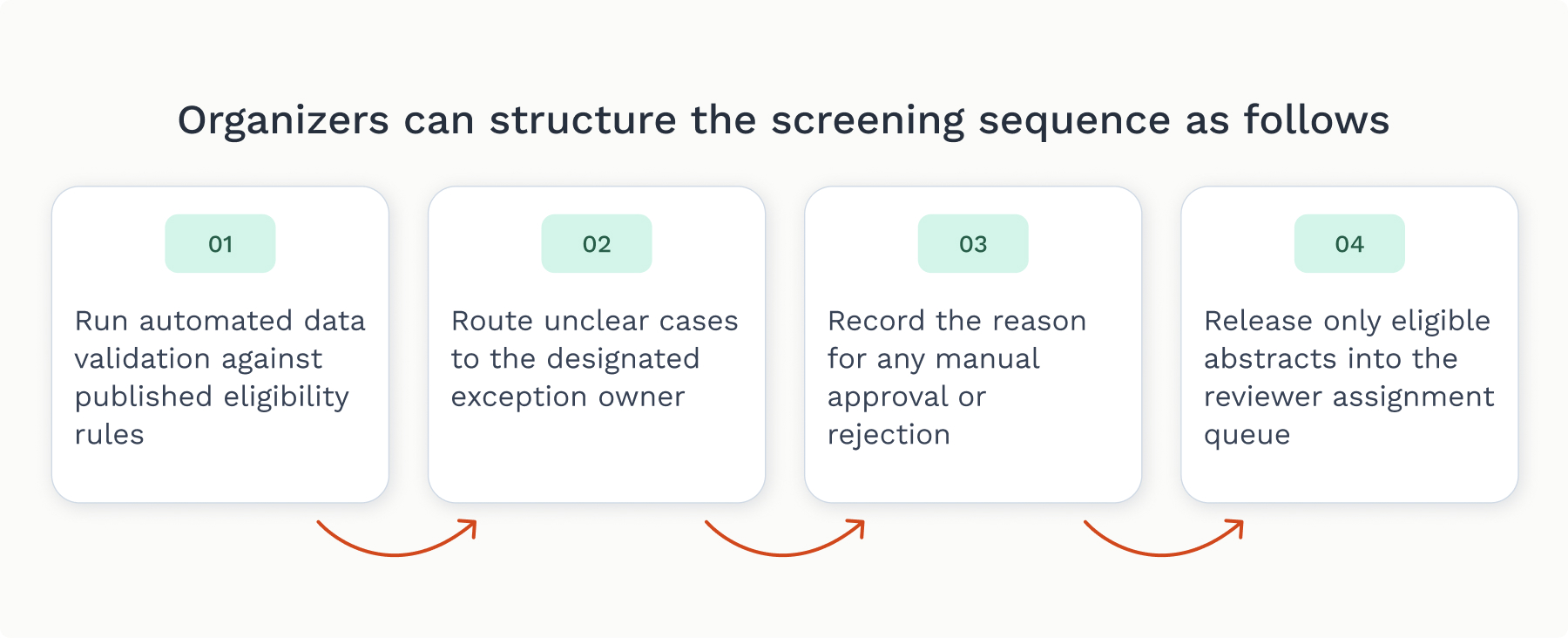
Organizers can structure the screening sequence as follows:
- Run automated data validation against published eligibility rules
- Route unclear cases to the designated exception owner
- Record the reason for any manual approval or rejection
- Release only eligible abstracts into the reviewer assignment queue
Not every association needs complex automation. A small annual meeting with a limited submission pool may handle screening manually. Even then, one checklist and one recorded owner are essential because informal exceptions are difficult to defend later.
Assign reviewers using three visible controls
Reviewer assignment should account for subject expertise, workload, and conflict of interest before invitations go out. Topic matching alone is not enough. An expert may already have a full queue, or the reviewer may have a professional connection that makes the assignment inappropriate.
Build an assignment view that shows each reviewer's subject areas, current abstract count, and declared conflicts beside every proposed match. When a conflict appears, the abstract returns to the unassigned queue rather than moving through an email exchange. When workloads become uneven, the program chair can redistribute assignments before deadlines start slipping.
A practical assignment record should capture:
- Reviewer expertise categories
- Assigned and completed review counts
- Declared conflict status
- Reassignment reason and owner
- Acceptance or decline of the review invitation
Manual matching can work for a small specialist committee, and many program chairs prefer the control it gives them. That preference is common, but it does not remove the need for an assignment record. The process still needs a documented assignment history so organizers can explain why an abstract reached particular reviewers and prevent one expert from carrying a disproportionate share.
Match the scoring model to the decision
A five-point rating is easy to understand, but it can hide why reviewers disagree. Weighted criteria work better when scientific quality and audience relevance carry different importance. Simple ratings remain valid when the decision is low-risk, and every criterion has roughly equal value. Complexity should follow the decision, not the size of the committee.
Calibration needs to happen before live scoring begins. Give reviewers a small set of sample abstracts, ask them to apply the scoring rubric, and compare how they interpret each criterion. A large spread signals unclear guidance, not necessarily poor reviewer judgment. Program chairs can then clarify the rubric before inconsistent scores affect real authors.
Review operations also need rules for blind review, deadlines, reminders, and incomplete scores. If review is blind, identifying fields must stay outside the reviewer's view, and organizers should check whether the abstract body reveals the author. Missing scores should never be treated as zero because that changes the outcome without a reviewer's decision. Reassign the review, extend the deadline under a named exception, or mark the abstract as pending.
Tie handling deserves the same clarity. If two abstracts finish with equal totals, organizers can compare the highest-priority criterion, request an additional review, or send both to the program chair. Pick the rule before scores arrive. Event teams wanting to examine how intake and decision records can remain connected can see how Swapcard works.
Govern decisions and preserve accepted data
Decision governance begins with thresholds, but it cannot end there. The process should define which scores lead to acceptance, rejection, or committee discussion, along with who may override the standard outcome. Every override needs a recorded reason, approver, and date. Without those details, an audit trail shows the final answer but not the judgment behind it.
Author notifications should pull from the approved decision record rather than a second spreadsheet. Templates can standardize acceptance, rejection, and revision messages, while case-specific comments remain attached to the submission. Before notifications go out, the program lead should check that each decision status has a matching message and that no pending abstract enters the send list.
Accepted records must then move into speaker management and session workflows without manual re-entry. Treat the abstract record like an attendee badge credential: the identifier should remain intact at every checkpoint, even as new information is added. Recreating the record for each team breaks that chain and makes later reporting less reliable.
A clean handoff maps each accepted field to a downstream use:
- Abstract title and summary feed the session record
- Author details feed speaker management
- Topic and format support session scheduling
- Decision and review data remain available for program analysis
- The submission identifier connects later corrections to the original record
Accepted does not mean publication-ready. Program teams may still edit titles, confirm speakers, or adjust session formats. Those changes should update the connected record rather than create a replacement, preserving the history from submission through the live agenda.
How Swapcard connects abstract and speaker records
Structured intake supports cleaner program records
A structured intake workflow captures abstracts through a defined form and keeps them connected to the event program through acceptance and beyond. Using Swapcard's Call for Papers, organizers can configure custom fields, route entries by category, and set clear submission deadlines. Accepted speaker and abstract information then carries forward into the program without requiring manual re-entry in a separate document.
Comments and decision tracking remain attached to submitted records, so the context behind acceptance stays visible when the program team prepares the agenda. Organizers who require a dedicated peer-review scoring workflow should verify whether that capability is available natively or through a documented integration before committing to a platform at that stage of the process. That distinction matters most for associations where complex blinded scoring is central to program selection.
Speaker follow-up keeps accepted data moving
Once an abstract is accepted, the Speaker Portal supports the next stage of the workflow. Organizers can manage approved speakers and session information without asking teams to recreate the submission from scratch. The approach reduces the risk of one title appearing in the decision record and another reaching the published agenda.
No platform removes the need for program judgment. Organizers still own eligibility policy, scoring design, and reviewer calibration. Technology provides the controlled record and handoff points, while the committee makes the content decisions. Program teams can map those responsibilities against the current process and get started with Swapcard when the handoff from accepted abstracts to speaker operations remains fragmented.
What a traceable abstract workflow protects
A traceable workflow protects review quality by preventing avoidable errors before they reach subject experts. Organizers can audit the current process by following several abstracts from intake to agenda placement, naming an owner at every exception, and checking where information is copied by hand.
The practical shift is straightforward. Validate predictable conditions at submission, reserve human judgment for content quality, document every decision, and keep accepted records connected to speaker and session operations. That is how an abstract review process reduces manual rework without weakening committee control.
FAQs
How do I prevent incomplete abstract submissions? To prevent incomplete submissions, design your submission forms carefully. Ensure that every required field directly supports eligibility and reviewer routing. You can use Swapcard's capabilities to create custom fields that capture necessary data while keeping forms concise. Additionally, implement conditional logic to show relevant fields based on the submission type. This way, authors only see what they need to fill out, which can significantly reduce errors and incomplete submissions.
What if I need to manage reviewer conflicts of interest? To manage conflicts of interest effectively, establish clear guidelines during the reviewer assignment process. Use Swapcard's reviewer assignment features to track each reviewer's expertise and declared conflicts. This allows you to ensure that abstracts are assigned to reviewers who are not only qualified but also free from potential biases. If a conflict arises, the abstract can return to the unassigned queue for reassignment.
Can I automate eligibility checks for abstract submissions? Yes, you can automate eligibility checks by using defined rules within your submission process. Implement a system that validates submissions against your eligibility criteria before they reach reviewers. Swapcard allows you to set up these automated checks, ensuring that only eligible abstracts move forward in the review process. This helps streamline your workflow and reduces the burden on reviewers.
When should I notify authors about their submission status? You should notify authors about their submission status after the review process is complete. Use a standardized template to communicate acceptance, rejection, or requests for revisions. With Swapcard, you can ensure that notifications pull from the approved decision record, maintaining clarity and consistency. This approach helps keep authors informed and engaged throughout the process.
Why does my abstract review process need a traceable workflow? A traceable workflow is essential because it protects the quality of the review process. It allows you to audit decisions and track each abstract from submission to final placement in the agenda. By using Swapcard's structured abstract management capabilities, you can ensure that every decision is documented, making it easier to address any questions or issues that arise later on.

Bhavya Sharma
Senior Content Marketing Manager
Shapes content strategy across the funnel at Swapcard, from awareness messaging to thought leadership, driving B2B SaaS growth through research-backed storytelling.


.png)


Join 12,000 subscribers and unlock industry secrets.
By submitting this form, you agree to receive periodic emails on insightful content related to events and our product, and in accordance with our Privacy Policy. You can, of course, change your preferences or unsubscribe at any time.



.svg)

.svg)
