


Hosted Buyer Program: How to run meetings that delivers ROI for buyers, sellers, and organizers
In today's event landscape, traditional networking formats often fail to deliver true business value. Attendees wander through exhibit halls, vendors pitch to the wrong audience, and organizers struggle to show clear ROI.
A hosted buyer event fixes that problem as organizers invite pre-qualified buyers with genuine purchasing authority, then guarantee them scheduled meetings with the exhibitors who matter most. The result is a curated marketplace where every meeting carries commercial intent.
This guide explains what a hosted buyer program is, how it works, how to qualify buyers, how to price the model, and how to measure the ROI it delivers.
- Hosted Buyer Events: Key Takeaways
- What Is a Hosted Buyer Program?
- How Does a Hosted Buyer Program Work?
- What Are the Benefits of Hosted Buyer Events?
- How to Implement a Hosted Buyer Program
- How Unified Software Lets You Scale a Hosted Buyer Program
- Swapcard: Four Program Modes From One Engine
- How to Qualify Hosted Buyers
- How to Match Hosted Buyers with the Right Exhibitors
- How to Build the Business Model Around a Hosted Buyer Program
- How to Promote Hosted Buyer Events and Recruit the Right Buyers
- How to Measure the Success of a Hosted Buyer Event
- Common Hosted Buyer Program Mistakes to Avoid
- Turning Hosted Buyer Programs Into a Recurring Revenue Engine
- Frequently Asked Questions About Hosted Buyer Programs
Hosted buyer events: Key takeaways
A hosted buyer program pairs pre-qualified buyers with relevant exhibitors through committed, pre-scheduled meetings. Below are the core points this guide covers.
- A hosted buyer program invites vetted buyers free or at reduced cost in exchange for a fixed number of scheduled meetings.
- Buyer qualification rests on three pillars: decision authority, budget control, and active sourcing intent.
- Smart matchmaking with AI recommendations and a human review step drives meeting relevance and acceptance rates.
- Exhibitors pay premium fees to access guaranteed buyer meetings, making the program a direct revenue engine.
- Five KPIs prove success: meeting completion rate, meetings per buyer, exhibitor satisfaction, declared pipeline value, and rebooking rate.
- Swapcard runs hosted buyer programs used across 4,000+ trade shows and conferences, with setup measured in days, not weeks.

What is a hosted buyer program?
A hosted buyer program is a structured networking model where pre-qualified buyers are invited to attend an event for free or at a reduced cost, in exchange for agreeing to a set number of pre-scheduled meetings with vendors or exhibitors. The organizer acts as matchmaker, connecting verified purchasing decision-makers with the sellers best positioned to serve them.
Buyers receive incentives such as covered travel, accommodation, and VIP access. In return, they commit to a set meeting agenda built around their sourcing needs. Exhibitors gain guaranteed face time with qualified prospects rather than hoping the right buyer walks past their stand.
Who should run hosted buyer programs?
Hosted buyer programs work best in high-consideration B2B contexts :
- B2B trade shows with defined buyer and seller categories
- Procurement and sourcing events where budgets are pre-allocated
- Investment summits matching capital with opportunity
- Destination and travel expos connecting agents with suppliers
- Technology showcases pairing solution buyers with vendors
What is the difference between a hosted buyer program and a hosted buyer event ?
A hosted buyer program is the mechanism the organizer runs: the engine for qualification, matchmaking, scheduling, and follow-up. A hosted buyer event is the show that hosts the program: the trade show, conference, or summit where the meetings take place. A single event can run several programs across different buyer segments.
How does a hosted buyer program work?
A hosted buyer program works by qualifying buyers, matching them with relevant exhibitors, scheduling their meetings, and measuring the results afterward. The goal is to ensure every meeting is planned, relevant, and commercially useful before anyone arrives onsite or joins online.
The lifecycle follows seven steps:
- Application: Buyers submit profiles and are evaluated based on budget, influence, and intent
- Qualification: Organizers screen applicants against defined criteria and approve or decline
- Matchmaking: Using AI or rules-based logic, buyers and sellers are presented with a list of their matches based on participant profiles Preference selection: Participants mark who they want or don’t want to meet
- Scheduling: Meetings are automatically scheduled with time slots, breaks, and buffers
- Meetings: Buyers and exhibitors meet onsite or online across the scheduled slots
- Follow-up: Organizers review attendance, collect outcomes, pipeline value, and satisfaction data after the event
A typical hosted buyer day might include 6 to 10 meetings, 15-minute breaks, one networking lunch, and open time for sessions or exhibition hall visits.
Scheduling is one of the most important steps, as it directly affects participant trust. If the agenda is relevant and well-balanced, buyers and exhibitors see value quickly. If it is filled with weak matches or back-to-back meetings with no breathing room, confidence drops.
Swapcard uses AI matchmaking to create a draft meeting agenda based on participant profiles, preferences, and interest signals. Organizers can then review the schedule privately, adjust specific pairings, prioritize key accounts, and send confirmations only once the meeting plan is ready.

What are the benefits of hosted buyer events?
Hosted buyer events deliver distinct benefits to buyers, as they save time by meeting pre-selected suppliers who fit their sourcing needs, exhibitors, who gain guaranteed meetings with qualified prospects, and organizers, who turn that guaranteed value into a premium revenue stream.
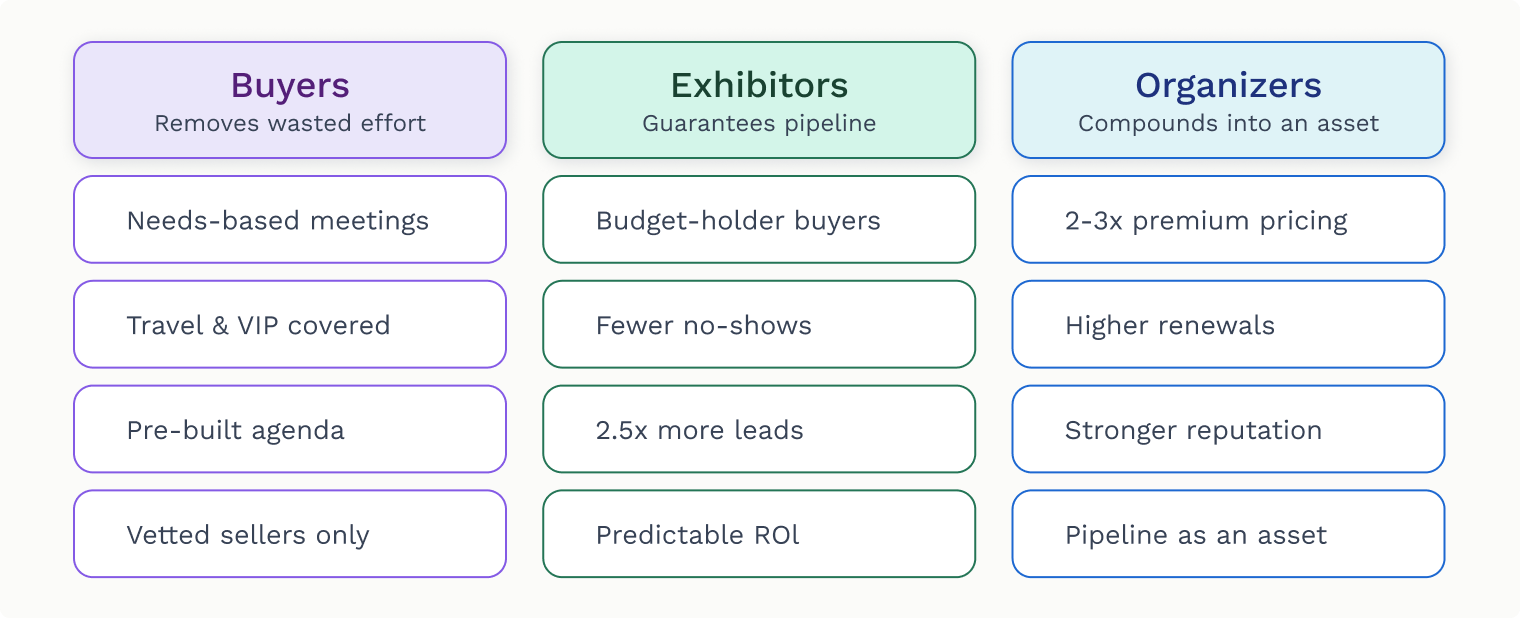
For buyers, the program removes wasted effort:
- Meetings arranged around real sourcing needs and timelines
- Covered travel, accommodation, and VIP access in exchange for time
- A pre-built agenda that turns a two-day show into a concentrated deal flow
- Access to sellers vetted for relevance rather than a crowded floor
For sellers and exhibitors, the program guarantees ROI and pipeline:
- Confirmed meetings with buyers who hold budget authority
- Fewer no-shows because meetings are committed in advance
- 2.5x more qualified leads captured when AI matchmaking supports the pairing
- A predictable return that justifies premium exhibitor spend
For organizers, the program compounds into an asset:
- A premium product that commands 2 to 3 times standard pricing
- Higher exhibitor renewal driven by demonstrable ROI
- A qualified buyer pool that strengthens the show's reputation
- Data on pipeline generated, which becomes the next sales pitch
How to implement a hosted buyer program
Implementing a hosted buyer program means setting up the operational framework before the first buyer applies. Organizers must define who qualifies, how to match participants, how to schedule meetings, and how to measure outcomes:
- Buyer and seller profiles: Define the exact roles, sectors, and company sizes on each side of the marketplace
- Qualification criteria: Set the thresholds that separate a hosted buyer from a general attendee
- Matchmaking rules: Configure whether matches require mutual interest or a single-sided request, and weigh the signals that drive recommendations
- Scheduling: Establish time slots, meeting length, and daily meeting caps per buyer
- Communications: Build the sequence that guides participants from confirmation to meeting
- Follow-up: Prepare the surveys and dashboards that capture outcomes
How unified software lets you scale a hosted buyer program
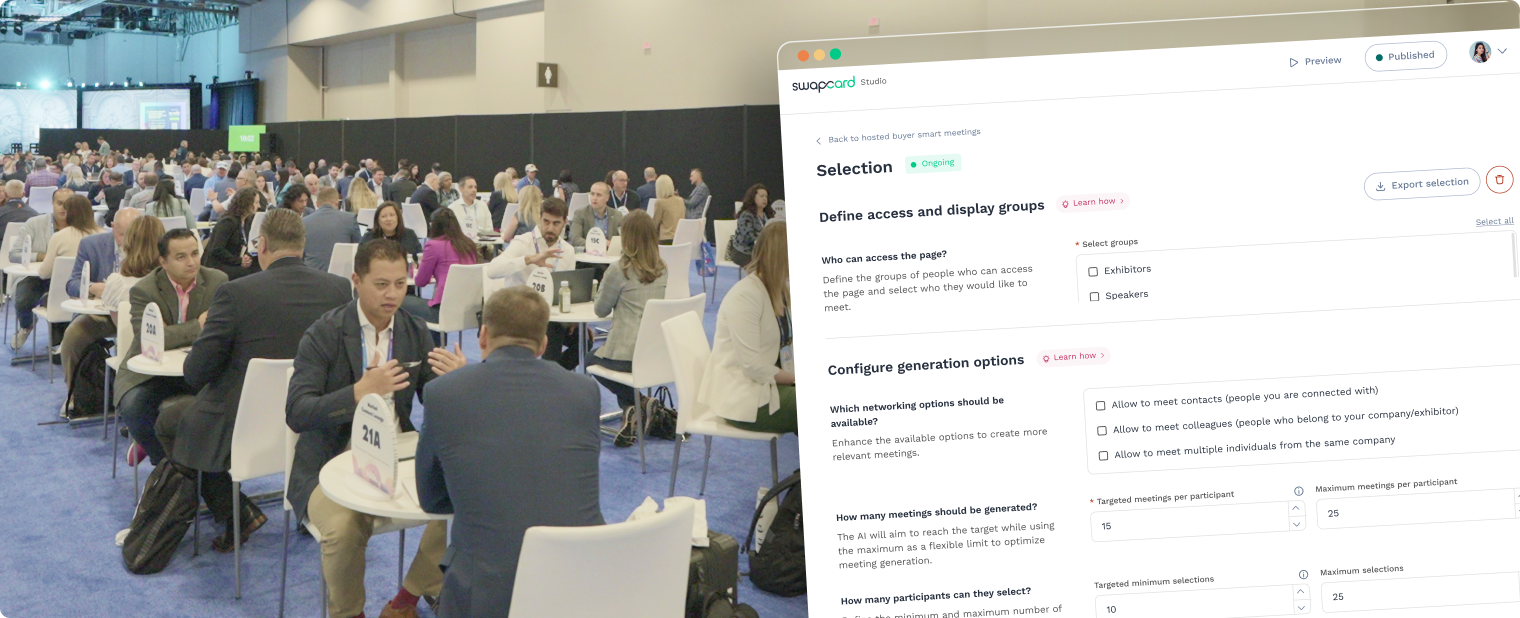
A hosted buyer platform lets organizers manage the entire program from one place: buyer qualification, seller profiles, meeting rules, daily caps, time slots, rewards, exhibitor packages, communications, and reporting. Instead of relying on spreadsheets and manual follow-ups, the software keeps the logic consistent across registration, matchmaking, scheduling, onsite execution, and post-event analysis.
Sign up buyers and sellers
The platform manages invitations, application forms, approvals, and confirmations. Buyers can apply online, while organizers review and approve qualified participants from a dashboard. Sellers and exhibitors can complete their own profiles, add company information, list products or services, and define the types of buyers they want to meet.
Set up the meetings
Once profiles are complete, buyers and sellers can express interest, rank preferred meetings, or identify must-meet contacts. The platform then uses this data to generate meeting schedules while respecting rules such as meeting caps, buffer times, availability, table assignments, and no double-booking.
Organizers can still review the schedule, adjust VIP meetings, fix unusual pairings, and push finalized agendas to participants by email or through the event app.
Run the day and track results
During the event, the platform becomes the control center. Participants can view their meeting agenda, table numbers, and updates from their phones. Staff can track attendance, manage no-shows, and adjust meetings if needed.
After the event, surveys, ratings, notes, and lead data help organizers measure how many meetings happened, how satisfied participants were, and what follow-ups are planned.
Swapcard: Four program modes from one engine
Modern hosted buyer programs are also versatile, curating relevant meetings for many types of programs. Swapcard supports multiple program modes from the same engine:
- Buyers meeting sellers in the classic trade show configuration
- Sponsor meetings that give partners guaranteed access to targeted attendees
- Pitch meetings with investors as a premium participant benefit
- Mentorship or career advisory matching that pairs mentees with mentors or candidates with recruiters
Organizers building their first program benefit from a proven operating model. Swapcard's guidance for hosted buyer program managers sets out how to qualify the right buyers and convert access into revenue. Additionally, Swapcard’s hosted buyer concierge services are available for managing all aspects of your program from setup to onsite management and reporting.
How to qualify hosted buyers
Qualifying hosted buyers means confirming that each applicant can actually buy before the program spends money hosting them. This is the single decision that determines whether exhibitors trust the program or abandon it.
Three signals of a qualified buyer
A qualified buyer shows three signals; each one answers a question an exhibitor asks before agreeing to meet :
- Decision authority : Can this person approve a purchase? A qualified buyer signs off on purchases or sits on the committee that does. Without authority, even a motivated buyer cannot move a deal forward.
- Budget control: Is there money to spend? A qualified buyer holds an allocated budget, or directly influences how it is used. Interest without budget produces conversations, not contracts.
- Active sourcing intent: Is there something to buy, and soon? A qualified buyer has a live project or a category to source within a defined window. Intent is what turns a meeting into a pipeline.
How to verify these signals at the application stage
At the application stage, the organizer must test these three signals rather than simply collect them. Every self-declaration is a claim to verify because the buyers most eager to be hosted are often the ones most likely to overstate their authority or budget. First, it must require proof, not just answers, because a signal that cannot be checked cannot be trusted :
- Role and job title, cross-checked against the company profile, because this is what confirms real decision authority.
- Procurement scope, meaning the categories the buyer actually spends on, because this is what confirms budget control.
- Project timeline, because an active purchase window in the near term is what separates a real buyer from vague future interest.
Route any applicant who meets two of the three signals to a short screening call or email exchange, and grant hosted status only when the sourcing intent is credible. Decline the others with respect and a way forward because a capacity-limited program turns people away for lack of space, not lack of value. Offer standard registration and encourage a future application, since this keeps the prospect warm

How to match hosted buyers with the right exhibitors
Matching hosted buyers with the right exhibitors means pairing each qualified buyer with the sellers they would actually buy from. Qualification proves a buyer can buy; matchmaking decides whether the meeting is relevant.
Matchmaking runs on four inputs working together:
- Profile data collected at registration: Sector, sourcing categories, company size, and stated needs
- Meeting preferences: Allow buyers and sellers to weigh in and indicate their preferences for who they want to meet and do not want considered
- AI-powered recommendations: An engine that ranks likely-relevant counterparts from profile and behavioral signals
- Human review: An organizer pass that validates and adjusts before anything publishes
How Swapcard runs the matching
Swapcard's hosted buyer software applies these four inputs automatically, then hands the draft slate back to the organizer for review :
- Participants express interest with three signals: Highly Interested, Interested, or Not Interested.
- Organizers configure selection rules to require either mutual interest or a one-sided request, depending on how curated the program should feel.
- From there, the AI drafts a full slate of meetings, which the organizer reviews and edits privately before publishing.
- Additionally, Swapcard offers a hosted buyer concierge service in which expert staff manage all aspects of your program, from setup to follow-up to onsite activities.
Swapcard's AI recommended leads improve connection acceptance rate. Two verified figures reinforce the point: exhibitors using AI matchmaking generate 2.5x more qualified leads, and without AI, 65 to 75% of meeting requests at large B2B events go unanswered.
Ready to build a hosted buyer program that pays for itself? Download The Definitive Guide for Profitable Hosted Buyer Programs and Smart Meetings for the frameworks, qualification templates, and pricing models organizers use to turn meetings into measurable ROI.
How to build a business model around a hosted buyer program
The business model behind a hosted buyer program rests on exhibitors and sponsors paying for guaranteed buyer access, and on ensuring that revenue exceeds the cost of hosting buyers. With this equation, hosted buyer events become the highest-margin product on the floor.
Buyers usually receive their hosted status for free or at a subsidized rate because their qualified presence is the product itself. Exhibitors and sponsors are the ones who pay, in exchange for guaranteed access to that product. This is why hosted buyer participation is best priced as a premium add-on, layered on top of standard exhibitor packages rather than baked into the base fee.
Before committing to a pool size, it helps to forecast both sides of the ledger:
- Hosting cost: Flights, hotels, ground transport, and hospitality per buyer, multiplied by pool size
- Program revenue: Exhibitor add-on fees, sponsor packages, and any monetized meeting sales
The strongest programs also draw revenue from several levers rather than a single exhibitor fee :
- Sponsorships tied to the hosted buyer program as a named benefit
- Exhibitor fees for guaranteed meeting quotas
- Partnerships with associations or media that co-fund buyer recruitment
- Premium scheduling placement, sold to exhibitors who want prime slots
- Branded meeting lounges that carry a sponsor's identity
- Tiered sponsor packages with a guaranteed number of buyer meetings per tier
Swapcard data shows hosted buyer programs command 2 to 3 times standard pricing, because exhibitors pay for outcomes rather than floor space. Frame every commercial conversation around pipeline generation, and connect it to broader event ROI so sponsors see the program as an investment, not a line item.

How to promote hosted buyer events and recruit the right buyers
Promoting a hosted buyer event means recruiting a small, specific population of qualified buyers rather than broadcasting to a mass audience. The goal here is precision, not volume, because a hundred right buyers deliver more value than a thousand wrong ones.
Where do the right buyers come from?
Recruitment tends to work best through channels where qualified buyers already gather :
- Industry associations that hold membership rosters of category decision-makers
- Vertical media partners whose audience matches your buyer profile
- Exhibitor referrals, since sellers know which of their prospects belong in the program
- Past attendee reactivation, targeting buyers who completed meetings in prior editions
- Targeted outreach to procurement and category leads identified by role and company
Why are incentives efficient?
Incentives are often what turn an interested buyer into a committed one. Travel reimbursement, covered accommodation, and VIP access matter most for senior roles whose time is scarce, and they can be the deciding factor in whether a qualified buyer confirms. It helps to position the meetings themselves as the real benefit, with the rewards acting as the enabler rather than the headline.
How to measure the success of a hosted buyer event
Measuring a hosted buyer event means tracking five KPIs that together prove whether the program generated commercial value :
- Meeting completion rate: The percentage of scheduled meetings that actually took place, exposing no-show and scheduling problems.
- Average meetings per buyer: The depth of each buyer's agenda, showing whether the program delivered on its meeting commitment.
- Exhibitor satisfaction score: Direct feedback on meeting quality, the strongest predictor of renewal.
- Pipeline value declared post-event: The monetary value exhibitors attribute to hosted buyer meetings, the closest proxy for ROI.
- Buyer and exhibitor rebooking rate: The percentage committing to the next edition, the clearest signal the program worked.
How to capture the data
These KPIs are easiest to trust when the event is instrumented to capture them automatically, rather than reconstructed by hand afterward :
- Real-time meeting dashboards track attendance and completion as the show runs, which gives organizers the chance to step in when a buyer's agenda thins out.
- Post-event surveys collect exhibitor satisfaction and declared pipeline while the experience is still fresh. Well-designed post-event survey questions turn that feedback into the case for next year's renewals.
Swapcard's own benchmarks show what strong measurement supports. A PCMA hosted buyer program recorded a 4.5 CSAT score with buyers holding budgets of $3M to $5M, evidence that qualification and matchmaking, tracked properly, produce buyers exhibitors want to meet again.

Common hosted buyer program mistakes to avoid
The most common hosted buyer program mistakes all share one root cause: treating the program as a logistics exercise rather than a curated marketplace:
- Under-qualifying buyers: Admitting attendees without real authority or budget floods exhibitor calendars with dead meetings and destroys renewal intent
- Overloading schedules: Cramming too many meetings into a day exhausts buyers and lowers the quality of every conversation
- Not tracking outcomes: Running the program without measuring pipeline leaves organizers unable to prove value or defend premium pricing
- Using manual tools and spreadsheets: Managing qualification, matchmaking, and scheduling by hand introduces errors, slows the process, and cannot scale
- Over-promising meeting volume to exhibitors: Guaranteeing a meeting count that the buyer pool cannot support turns a selling point into a broken promise
- Ignoring exhibitor feedback between editions: Failing to act on satisfaction data repeats the same mismatches year after year
- Treating no-shows as inevitable: Accepting missed meetings as normal ignores fixable causes like poor reminders, bad scheduling, or weak qualification
Turning hosted buyer programs into a recurring revenue engine
A well-run hosted buyer program can become one of your event’s most profitable recurring revenue streams. It gives exhibitors guaranteed access to qualified buyers, creates a premium product to sell year after year, and builds measurable proof of value with every edition.
What starts as a break-even initiative in year one can become a flagship revenue product by year three, especially when the operational foundation is strong. Qualification, matchmaking, scheduling, communications, and reporting need to run consistently so each edition builds on the last rather than starting from scratch.
Swapcard helps organizers run hosted buyer programs across 4,000+ trade shows and conferences, with setup taking days rather than weeks. Organizers can combine AI-powered automation with a human concierge service for high-touch programs. Explore Swapcard’s hosted buyer software, then book a live demo to see how it can be mapped to your event.
Ready to build a hosted buyer program that pays for itself? Book a live demo and see how Swapcard turns curated meetings into measurable ROI.
Frequently asked questions about hosted buyer programs
What features should I look for in hosted buyer software?
The best hosted buyer platforms combine buyer qualification, matchmaking, meeting scheduling, communications, reporting, and lead capture in a single system. Look for software that integrates with your registration platform, automates participant communications, provides real-time reporting, and gives organizers full visibility into meetings, attendance, and outcomes.
How many meetings should a hosted buyer commit to?
Most programs ask hosted buyers to commit to a set daily quota that fills the agenda without exhausting them, commonly 6 to 10 meetings per day with short breaks between them. The right number balances exhibitor demand for access against meeting quality, so cap daily meetings and protect time for depth.
How much does it cost to run a hosted buyer program?
The largest expense is usually the cost of hosting qualified buyers, including travel, accommodation, and hospitality. However, these costs are often offset by premium exhibitor packages, sponsorship opportunities, and paid meeting programs. Because exhibitors gain guaranteed access to qualified buyers, hosted buyer programs typically generate a strong return on investment while creating additional revenue opportunities for organizers.
How long does it take to set up a hosted buyer program?
With modern hosted buyer software, most programs can be configured within days rather than weeks. Organizers define participant groups, qualification criteria, meeting rules, and schedules through guided workflows instead of manual spreadsheets. Larger events may require additional planning, but the technology significantly reduces operational workload.
Can hosted buyer programs be used for virtual and hybrid events?
Yes. The same qualification, matchmaking, preference selection, and scheduling process works for in-person, virtual, and hybrid events. Virtual meetings remove travel constraints, making it easier to connect qualified buyers and suppliers across different regions while using the same matching logic and reporting tools.

Jessica Duarte
Product Marketing Manager | Swapcard
Shapes product marketing and go-to-market strategy at Swapcard, drawing on a background in event technology consulting and cross-functional digital marketing leadership.



.webp)

Join 12,000 subscribers and unlock industry secrets.
By submitting this form, you agree to receive periodic emails on insightful content related to events and our product, and in accordance with our Privacy Policy. You can, of course, change your preferences or unsubscribe at any time.


.svg)

.svg)
