


What Is Conference Attendee Engagement? Definition, Benefits, and Metrics
A 1,200-person conference can look successful on the badge report and still miss the engagement signals exhibitors need to renew. Real conference attendee engagement shows up earlier: saved sessions, booked meetings, exhibitor profile views, booth bookmarks, and follow-up-ready leads. Attendance fills the room; behavior proves whether the room created commercial value.
Event organizers know the drill all too well: registration opens, the agenda goes live, exhibitors ask about lead quality, and the onsite team moves into high-alert mode. The mistake is treating attendee engagement as something that happens during the event, when the real work starts weeks earlier and continues after the booths come down.
Key Takeaways:
- Conference attendee engagement should be measured by meaningful actions, not passive counts.
- App adoption matters only when it creates usable behavior data for matchmaking, lead capture, and exhibitor reporting.
- Organizers should open engagement channels at least 6 weeks before the event to capture early intent.
- Badge scans alone miss a large share of buyer signals, including bookmarks, meetings, profile views, and session activity.
- Exhibitor renewal depends on proof: qualified leads, meetings booked, sponsorship delivery, and revenue tied back to engagement.
Why conference attendee engagement breaks before the doors open
Conference attendee engagement breaks when organizers wait until onsite to activate the audience. By then, attendees have already made decisions about which sessions to attend, which exhibitors to visit, and whether the event feels worth their time. The real problem is not low energy on the show floor, it is a late start to intent capture.

Attendance is not the engagement metric that matters
Attendance has value, of course. No organizer wants an empty ballroom or a quiet expo hall. But attendance alone does not show whether a trade show created qualified conversations, whether an association annual meeting built member value, or whether a sponsor reached the audience it paid for. The Center for Exhibition Industry Research has long emphasized buyer quality as a core value of exhibitions, with many trade show attendees holding buying influence or authority.
The hidden issue is that attendance gets counted because it is easy. Engagement takes more work because it requires organizers to connect behavior across registration, session management, mobile app activity, matchmaking, lead capture, and exhibitor follow-up. When those systems sit apart, organizers end up stitching together CSV files after the event and calling it analysis. That is not strategy. That is cleanup.
A conference director at 7:15 a.m. on opening day sees the problem in real time. The registration line is moving, badge printing is working, and the keynote room is filling up, but exhibitors are already asking why buyers have not pre-booked meetings. Marketing has app download numbers, sponsorship has impression counts, and operations has check-in data. Nobody has one clear answer to the commercial question: who is actually engaging, and with whom?
The pattern is familiar because it has become normal. Normal does not mean acceptable.
The fragmentation tax shows up in exhibitor renewal
Event teams often run registration in one system, the mobile app in another, lead retrieval in a third, and analytics in spreadsheets. Each tool may work on its own, but the gaps between them create a cost that is hard to see until renewal season. Exhibitors do not renew because a dashboard showed 8,000 app opens. They renew when organizers prove who visited, who engaged, who booked meetings, and which leads were worth follow-up.
There is a fair argument for point solutions. Some are strong at one job, and smaller conferences may not need a full event platform if they only run a simple single-track program. That is valid. The issue appears when an organizer is running a multi-track B2B conference, a hosted buyer program, or a trade show with hundreds of exhibitors and still tries to prove return on investment from disconnected data.
Freeman’s event research has pointed to rising pressure on organizers to create more measurable attendee experiences, especially as brands scrutinize spend across channels. That pressure lands hardest on the teams responsible for exhibitor success. Without connected engagement data, they are left defending the event with partial evidence.
For organizers comparing registration, mobile app, matchmaking, and lead capture models, the first question is whether attendee behavior can stay connected from sign-up through follow-up. A useful next step is to learn more about Swapcard and compare that connected workflow against the current tool stack.
How organizers turn attendee activity into measurable engagement
Organizers turn attendee activity into measurable engagement by designing the event around intent signals. The aim is to guide attendees toward relevant people, sessions, and exhibitors, while capturing the actions that prove value. Strong engagement systems do not start with more notifications, they start with better data design.
Diagnose whether engagement is active or just visible
A healthy engagement program has more than app opens, session views, and badge scans. Those numbers show visibility, but active engagement shows intent: bookmarked exhibitors, saved sessions, accepted meetings, in-app messages, lead qualification scores, and repeat profile views. If fewer than 40% of registered attendees take at least one intent-based action before the event, the event team is probably launching too late or asking attendees to do too much onsite.
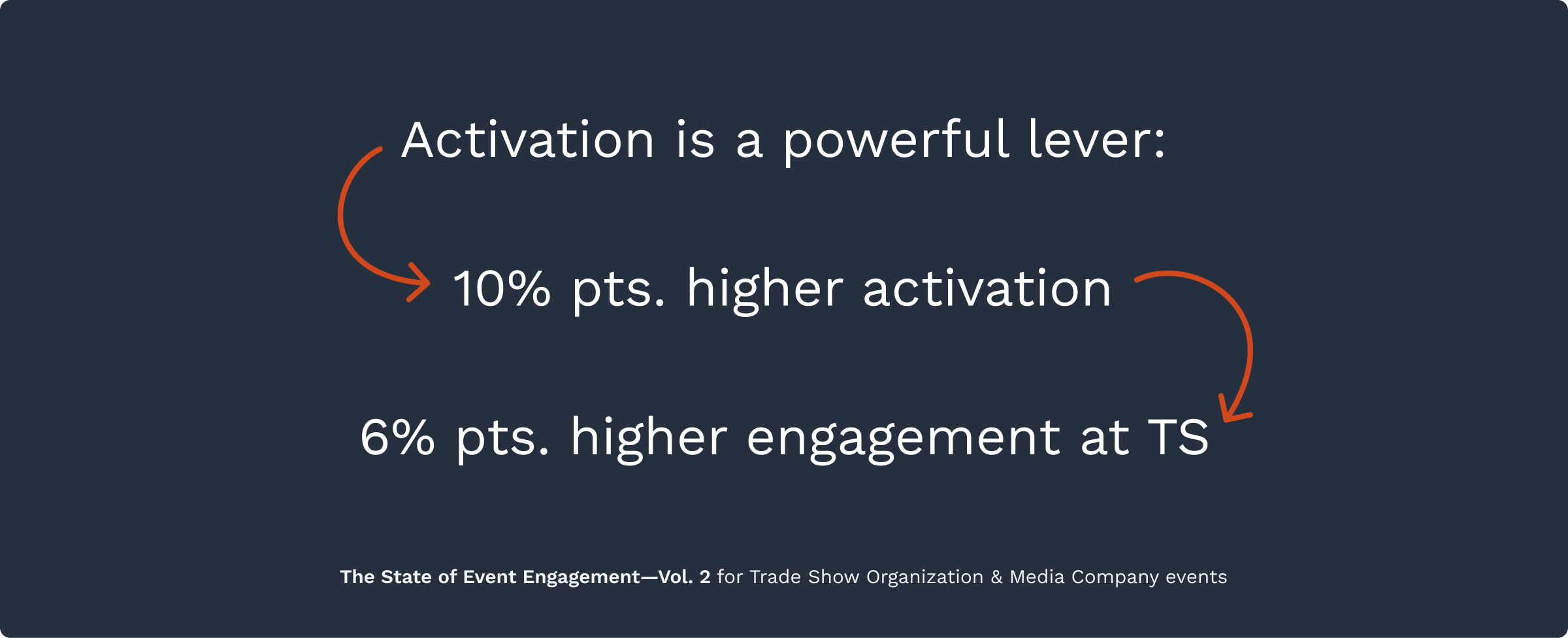
Use a simple diagnostic before the next conference. Are attendees building schedules before they arrive? Are exhibitors receiving profile views or meeting requests before booth setup? Are sponsors getting measurable interaction beyond logo impressions? Are session recommendations tied to attendee roles, interests, or past behavior? If the answer is no to three of those four questions, the issue is not promotion volume. The event lacks an engagement path.
There is a practical way to separate activity from engagement:
- Passive signals: app opens, page views, agenda browsing, email clicks.
- Intent signals: saved sessions, bookmarked exhibitors, meeting requests, chat messages.
- Commercial signals: qualified leads, accepted meetings, sponsor content interactions, CRM-ready follow-up.
- Retention signals: repeat participation, exhibitor renewal interest, sponsor package expansion.
The useful threshold is not perfection. Organizers should aim for at least one intent signal per active attendee before onsite check-in begins. That target forces the team to activate the audience early enough for exhibitors to act, instead of discovering buyer interest after the event is over.
Open the platform 6 weeks before onsite
Conference attendee engagement grows when attendees have time to plan. Opening the event app 2 days before the show may increase downloads, but it rarely gives buyers enough time to discover exhibitors, request meetings, or build a useful schedule. Based on event engagement benchmark discussions across large in-person programs, up to 65% of networking can happen before the event begins, which makes early activation a revenue issue, not just a communications task.
.png)
The sequence matters. At 6 weeks out, release attendee profiles, exhibitor listings, and basic agenda tracks. At 4 weeks out, open meeting requests and recommendation prompts. At 2 weeks out, send tailored nudges based on incomplete profiles, empty schedules, or missed exhibitor matches. During the final week, stop sending generic reminders and focus on specific actions, such as booking 3 meetings or saving 5 relevant sessions.
Some organizers worry that opening engagement too early creates stale activity or support questions. That concern is fair. Early access without a plan can confuse attendees, especially if the agenda is unfinished or exhibitor profiles are empty. The better rule is conditional: if at least 70% of exhibitor profiles and 80% of core sessions are ready, open the platform; if not, delay by one week and use that time to complete the content that drives discovery.
At IAAPA Expo, the scale made early digital touchpoints especially important. The event had an 11-mile show floor, which is not something attendees can navigate well with a static PDF and good intentions. Their digital experience supported more than 7,000 active app users, 23,500 agenda interactions, 8,500 connection requests, and 6,500 discussions. One organizer described the value plainly: “Because we’re a global organization, we actually needed to be able to have a touchpoint with all of these individuals, and having Swapcard was a really great way to do that.”
Build engagement around exhibitor goals first
Attendee engagement improves when organizers connect it directly to exhibitor goals. That may sound backwards, because attendee experience usually sits with operations or marketing, while exhibitor return on investment sits with sales. In practice, the two are joined. Attendees want relevant discovery, and exhibitors want qualified conversations. The same signals serve both sides.
Start by asking exhibitors to choose one primary goal before the event: lead volume, lead quality, product demos, brand visibility, or meetings with named account types. Each goal should map to a different engagement path. A lead volume exhibitor needs booth traffic and scan tools. A lead quality exhibitor needs qualification questions and meeting rules. A demo-focused sponsor needs scheduled sessions, content bookmarks, and follow-up lists tied to specific offers.
The mistake is giving every exhibitor the same playbook. A medical device company seeking hospital procurement leaders does not need the same path as a SaaS sponsor trying to build awareness with association executives. If the organizer treats both as booth traffic problems, neither gets the data needed to prove value. Engagement becomes a crowd management exercise instead of a commercial engine.
A practical rule works well here: if an exhibitor cannot explain how they will use a lead within 48 hours of receiving it, the organizer should require a simpler qualification setup. Three questions are enough for most booths: buying timeline, area of interest, and follow-up preference. More than 5 questions usually slows booth staff down, especially during peak traffic. Less can be more, provided the answers shape follow-up.
Treat digital touchpoints as lead signals, not app activity
Digital engagement is not a side channel anymore. It is often where the strongest buyer intent appears, especially before attendees ever step into the venue. In Swapcard’s event engagement research, 67-85% of leads can come from digital touchpoints rather than onsite badge scans, depending on the event type. That includes exhibitor bookmarks, chat activity, meeting requests, session views, and other digital actions that reveal interest before a booth conversation happens.
McKinsey research shows that across industries that personalization drives stronger commercial outcomes when experiences respond to user behavior, not broad segments. Events have the same opportunity. Attendee behavior can guide recommendations toward sessions, exhibitors, hosted buyer meetings, and sponsor content that actually match intent.
The key is to avoid treating every digital touch as equal. A profile view is light interest. A saved exhibitor is stronger. A meeting request is stronger still. A booth QR scan plus a qualification score is a handoff-ready lead. The value comes from ranking the signals and showing exhibitors which actions deserve immediate follow-up.
A simple scoring model can work without overcomplicating the process:
- Give light actions, such as views or clicks, a low score.
- Give saved exhibitor profiles, document downloads, and sessions bookmarks a medium score.
- Give meeting requests, accepted meetings, booth scans, and qualification answers a high score.
- Prioritize leads with both digital and onsite signals.
Organizers that make this shift stop asking whether attendees used the app. They start asking whether attendee behavior created commercial proof.
Design sponsorship packages around outcomes
Sponsors are no longer satisfied with visibility alone. Logo placement, banner ads, and lanyard branding still have a place, but they rarely carry the full renewal conversation. Sponsorship value now depends on whether organizers can show who engaged, what action they took, and how that action connects to the sponsor’s goal.
The better approach is to package sponsorship around measurable outcomes. A brand awareness package might include promoted content views, session attendance, and post-session ratings. A lead generation package might include marketplace placement, meeting opportunities, and qualified lead delivery. A thought leadership package might connect sponsored sessions to attendee profiles, Q&A participation, and follow-up interest.
There is a real tradeoff. Outcome-based packages require more planning than a static prospectus, and sponsorship teams must collect goal information earlier in the sales cycle. That extra work pays off because it gives organizers a clearer story before renewal. Instead of saying “your logo was seen,” the team can say “your sponsored session generated 214 saves, 73 qualified profile interactions, and 18 requested follow-ups.”
The condition is simple: if a sponsor cannot name the action they want attendees to take, do not sell the package yet. Define the action first. Then build the inventory around it. That protects the sponsor, the organizer, and the renewal conversation.
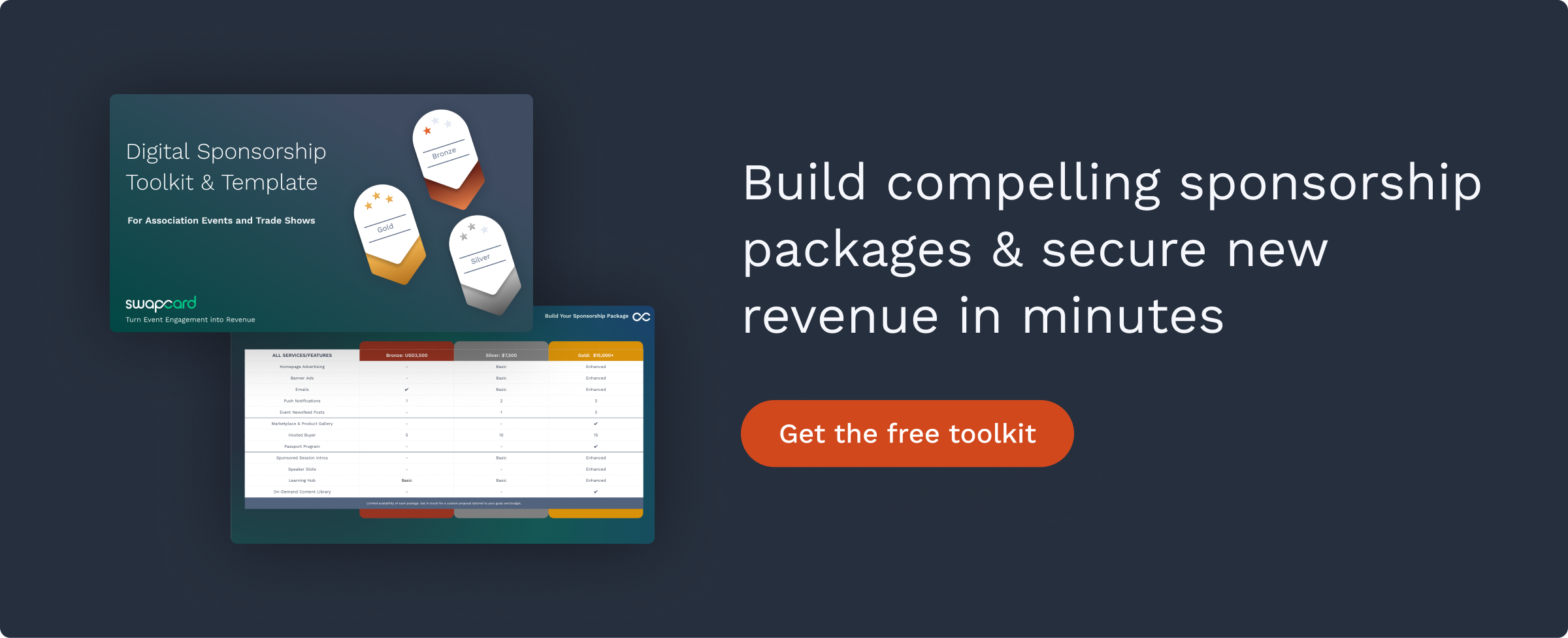
For teams trying to connect sponsorship inventory, attendee actions, and exhibitor follow-up in one view, the working question is no longer whether engagement is high. It is whether engagement is traceable. That is the right moment to see how Swapcard works across registration, app activity, matchmaking, and lead capture.
Use onsite design to reduce missed opportunities
Onsite engagement depends on removing friction from the attendee path. If attendees cannot find the right booth, understand which session fits their role, or scan into the right room without delays, they miss interactions that could have become qualified leads. Being pressed for time is a given at large trade shows and association events. The event design has to respect that reality.
A useful test is the 3-minute rule. From any point in the event app or venue map, an attendee should be able to identify one relevant session, one relevant exhibitor, or one relevant meeting opportunity within 3 minutes. If that takes longer, the event is asking too much from a person already juggling sessions, meetings, inboxes, and travel logistics.
Wayfinding plays a bigger role than many organizers expect. Interactive floor plans, searchable exhibitor profiles, and saved booth lists reduce decision fatigue, especially at large conferences where the physical space is part of the challenge. The analogy is simple: a show floor without connected digital guidance is like a city with street names but no map. People may still find their way, but they waste time, miss turns, and skip stops they would have made with better direction.
GL Events’ BePositive shows why digital adoption changes the whole engagement model. By moving to a mobile-first experience with digital badges, early interactive map access, tailored visit routes, meeting recommendations, exhibitor QR codes, webinars, and exhibitor onboarding, attendee app adoption jumped from 20% to nearly 100%, exhibitor adoption reached 80%, business meetings increased 3x, and attendee-to-attendee connections doubled. The lesson is not that every event should remove paper overnight. The lesson is that onsite engagement improves when attendees have one reliable place to plan, navigate, meet, and act.
How Swapcard connects engagement to revenue proof
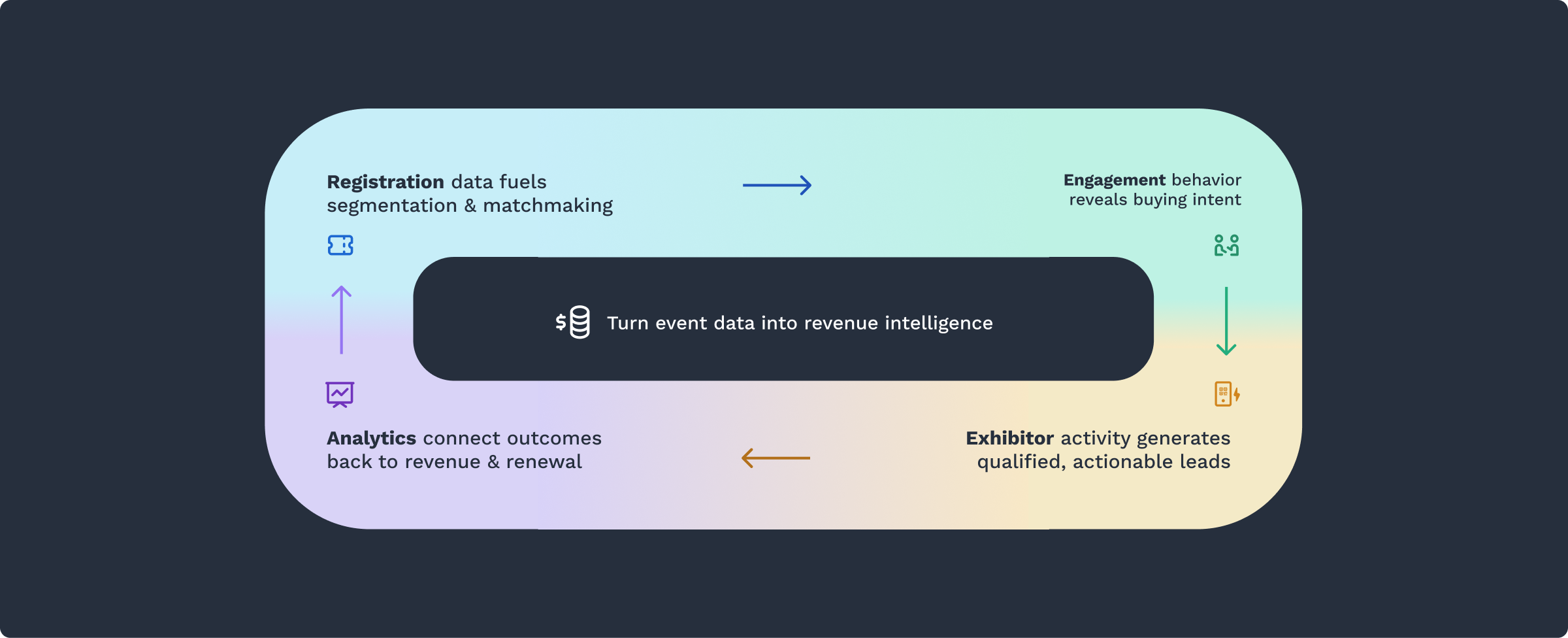
Swapcard connects engagement to revenue proof by keeping registration, app behavior, AI matchmaking, exhibitor lead capture, and analytics in one event workflow. That connected data model gives organizers a clearer view of attendee intent and exhibitor value. It also reduces the manual work of rebuilding the event story after the show.
Connected attendee and exhibitor data
Swapcard gives organizers one data model across Registration, the Branded App, AI Matchmaking & Recommendations, Smart Meetings & Hosted Buyer, Marketplace, Lead Capture & Qualification, and the Exhibitor Lead Center. That matters because conference attendee engagement only becomes useful when the same attendee profile connects to sessions saved, meetings booked, exhibitors viewed, leads captured, and follow-up activity. Without that connection, engagement is just scattered evidence.
The platform’s AI Matchmaking & Recommendations uses profile data and behavior signals to suggest relevant attendees, speakers, sessions, and exhibitors. Smart Meetings and Hosted Buyer programs add structure for curated meeting formats, with pre-configured groups and time slots for qualified buyer-exhibitor conversations. Lead Capture & Qualification sends everything to the Exhibitor Lead Center — scanned badges, booth QR activity, business card scans, qualification forms, and scores.
That structure addresses the earlier cost of fragmentation. Instead of registration data living apart from app behavior and lead capture, Swapcard keeps the journey connected from sign-up to follow-up. One customer phrased the operational value directly: “Swapcard helped us with the integration of data across our different business units...has helped my team save 2 weeks of work per event.” For portfolio teams running multiple conferences, that time matters.
Revenue analytics for exhibitor renewal
Swapcard is built for the renewal conversation because it connects engagement data to exhibitor outcomes. Organizers can track meeting activity, lead capture, qualification scores, sponsor interactions, Marketplace engagement, and other signals that show whether an exhibitor received value. That moves the conversation away from vague satisfaction and toward evidence.
The commercial thread is especially important for trade shows and association conferences where exhibitors expect more than booth traffic. Marketplace profiles, Item Gallery content, Sales Booth offers, Booth QR Code scans, and Lead Center records give exhibitors multiple ways to be discovered and measured. Hosted Buyer and Smart Meetings can add a premium meeting layer for events where qualified buyer access is part of the revenue model.
Swapcard does not replace a customer relationship management (CRM) system, marketing automation, accounting, or project management tools. It sits in the event workflow where attendee behavior, exhibitor engagement, and lead data are created. That distinction matters because organizers still need their broader commercial stack, but the event platform must own the signals that prove what happened during the event.
For organizers ready to replace post-event spreadsheet stitching with engagement data that supports exhibitor renewal, Gget started with Swapcard and review how the platform connects Registration, AI Matchmaking, Lead Capture, Marketplace, and analytics in one workflow.
Turn attendee engagement into exhibitor proof
Conference attendee engagement is not a campaign metric. It is the operating system for exhibitor return on investment, sponsor value, and renewal confidence. Organizers that measure only attendance, downloads, and session counts will keep missing the signals that show whether buyers and sellers actually connected.
The path forward is practical: activate attendees early, capture intent across digital and onsite touchpoints, design exhibitor journeys around goals, and connect every meaningful action to a revenue story. Attendance may fill the room, but engagement proves the event was worth coming back to.

Blessing Lola A.
Senior Content Marketer
Leads content strategy and execution at Swapcard across guides, articles, and event materials, using performance data and AI-powered tools to sharpen messaging and scale output.


.webp)

Join 12,000 subscribers and unlock industry secrets.
By submitting this form, you agree to receive periodic emails on insightful content related to events and our product, and in accordance with our Privacy Policy. You can, of course, change your preferences or unsubscribe at any time.
.svg)


.svg)
.svg)
.svg)
.svg)


